
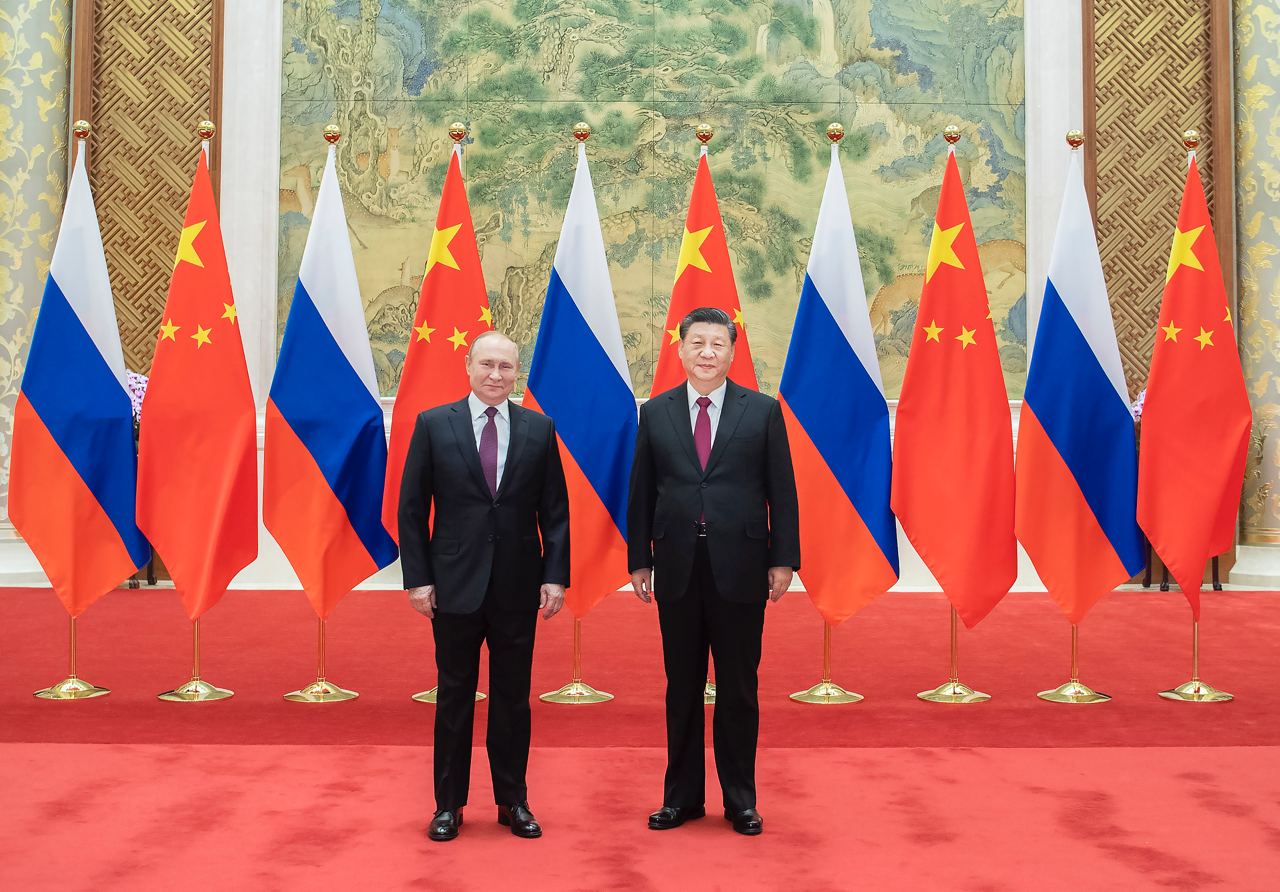
Russian gas and Chinese chips: the "barter" that worries Trump
According to Trump, the West is inadvertently financing the rise of an alternative bloc. "Ukraine is only the pretext: the real game is replacing the dollar".
by Valerio Giunta, CEO of Startup Italia and Banking People
The more pressure the United States exerts on Russia and China, the more valuable their relationship becomes in easing Western pressure and showing the world they are not isolated," says Andrea Kendall-Taylor, an international security expert. Donald Trump turns this analysis into a direct attack on Biden's policy in Ukraine. "The longer this war goes on, the more Russia throws itself into the arms of China. We are the losers," he said bluntly at several rallies before becoming president, condensing his view into a phrase that today weighs like a ton of bricks.
The president accuses Moscow and Beijing of turning the conflict into a business deal: Russia supplies the gas, China supplies the technology. "It’s still a small market, but one paid for with American money." According to Trump, the West is inadvertently financing the rise of an alternative bloc. "Ukraine is only the pretext: the real game is replacing the dollar," he added, referring to the efforts of the BRICS (Brazil, Russia, India, China, South Africa plus the newly added members) to bypass the American currency. Trump will have none of dedollarization: "If the BRICS try to bury the dollar, I’ll bury them with 100% tariffs. Simple." His obsession? That club — Brazil, India and the others who think they’re clever — pushing to pay in yuan or in "paper money." "The dollar is under attack, and we’re sitting here financing a war that weakens us," he was already claiming in 2023, during the election campaign, pointing the finger at Biden.
In short, Trump's strategic approach is the same one used by Kissinger and Nixon in the early 1970s (with Nixon's famous visit to China in '72), when they chose to bet on China's growth in order to split the communist front between Russia and China. Now Trump is trying to use the same method, but to achieve the opposite effect: to flatter Russia (by quickly "switching off" the armed conflict in Ukraine) and pull it away from an unlimited partnership (economic, political and military) with China.
On the military front, Trump argues that there are deals nobody dares to admit. Chinese soldiers in Donbas? Russian weapons being tested by Beijing? It’s all connected. And he warns of an apocalyptic outcome: "If we don’t stop this farce, in ten years we’ll be buying gas in yuan. And Wall Street will turn into a parking lot." His solution? "Come on then: no NATO in Ukraine, a deal with Putin, and Russia will go back to fighting with China." But he admits: "Europe won’t like it, but better an angry ally than a dead dollar." So here is the shock prescription: "Stop NATO, give Putin an exit route." And on the BRICS he ends with a joke: "That acronym is like a cover band: they play old hits, but unplugged." The message is clear: for Trump, every day of war is a gift to China. "And we’re the suckers paying the bill."
Why does Trump keep insisting on this? For the president, every day of war is a step toward a multipolar world dominated by Beijing. His recipe — sanctions, tariffs, threats and improvised deals — aims at one goal: "Keeping America on top, at any cost." With or without allies. Meanwhile Europe, in a panic, can only look for plausible reasons to disengage from Ukraine. In fact, while Trump thunders against the Russia-China alliance, in Europe the wall of support for Kiev is cracking. Two summits in Paris, called by Macron, ended in two complete busts. Giorgia Meloni was there, but through gritted teeth: in Italy, backing Ukraine has now become like defending taxes — the more you do it, the more they hate you. The problem? Governments have discovered that Washington’s line was an economic trap and also a temporary one, and now they are certainly looking for a discreet way out.
European and Ukrainian information? Paid for by the USA through USAID
Documents that have recently leaked reveal what many suspected: think tanks and European media pushing for support for Kiev were funded by US money. A dirty game to steer the narrative and force governments to follow Biden’s line, turning Europe into an American megaphone before Trump. The result? Politicians rode the wave so as not to lose consensus, but now that the tide is receding, they are left exposed. And so, in a frantic search for the perfect excuse to abandon Kiev, European politicians have already started thinking about how to make the disengagement plausible without losing face, perhaps by digging up buried skeletons:
1. Did Zelensky Bomb Donbas? We have known for years: the Ukrainian attacks on pro-Russian civilians, hidden by the media, are now becoming proof of Kiev's double face;
2. the Russia bombings of civilian facilities were due to the fact that Ukraine hides weapons inside them (as denounced by Amnesty International in the summer of 2022);
3. corruption in Ukraine: the billions from the West? Spent on Porsches and yachts and lavish villas in Tuscany, Sardinia and California. Arms funds enriched oligarchs, they did not defend the front line;
4. failed strategy: two years of war for zero results; the Ukrainian offensive is a total bust, and European citizens are starting to ask: what was this all for?".
Meanwhile, Germany is one step away from surrender. The economy is in recession and public opinion is against Scholz, pushing Berlin to forget moral sermons and think about gas. In today's German political elections, according to the first exit polls the conservative CDU/CSU of Friedrich Merz win the elections in Germany with 29%. But the far right of Afd led by Alice Weidel comes out strongly at around 20%, an exploit never before achieved in the history of the Federal Republic. This scenario will force the CDU into a coalition government with the SPD — which has lost a great deal of support because of Sholz's failed policy — and at least one of the other minor parties. Macron, who has also played the hawk, knows that his electorate is tired, and this has been widely shown by the latest European and then national elections: between the yellow vests and the missiles to Kiev, it will always choose the former.
So what remains? Europe is at a crossroads: keep being an "American colony" or rediscover itself as a leading player. But to do that, it should admit two uncomfortable truths:
- We followed Washington like watchdogs;
- Now it’s up to us to clean up the mess.
There would also be a third: the Ukrainian raw materials are being split up by the US and Russia.
What fools.
Related articles


Newsletter
The Patrimoni & Finanza newsletter
A considered selection of analysis on economy, Real Estate and wealth
The subscription service is not connected yet: no address is stored