
The European Question, Part II: the death of Pope Francis, a “miracle” of involuntary diplomacy
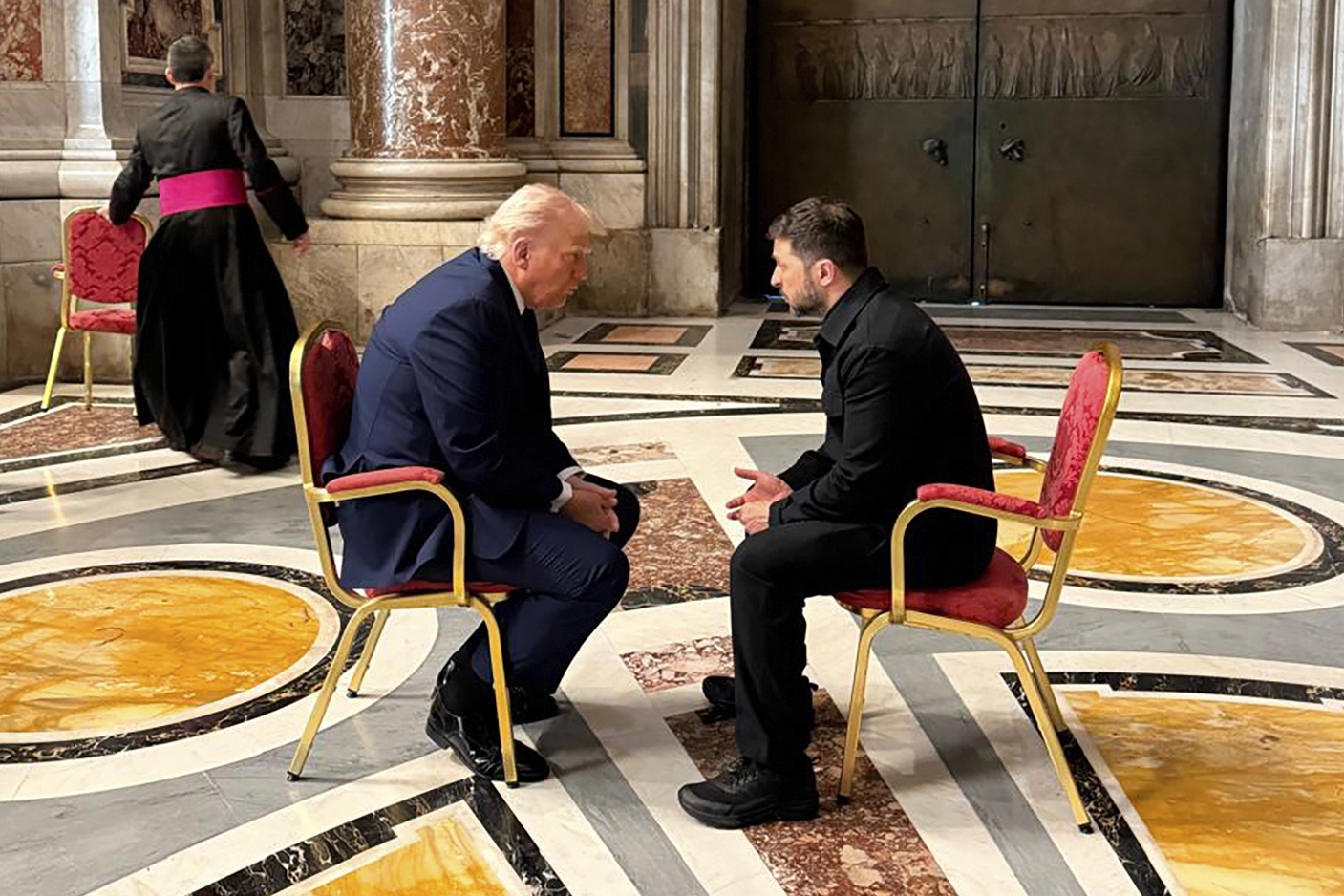
The death of Pope Francis upended the plans of Europe’s recalcitrant leaders, who were forced by circumstances to play second fiddle to the Trump-Zelensky showdown under the aegis of Giorgia Meloni’s Italy.
By Alessio Cardinale
Never before in the last 6 months has the true nature of the European Union been laid bare, with its load of international fragility exposed in the face of events that, moreover, were widely anticipated. The election of Trump to the presidency of the United States was, for Von Der Leyen & co., anything but the classic surprise you never saw coming, just as Trump’s intentions – for those who toss around Anglicisms without knowing what they mean, “Tycoon” in Italian means “magnate” – regarding the trade policy to be pursued toward the hated European competitors were hardly a mystery.
Any genuine federation of states, faced with the advance of the most feared international scenarios, would have reacted in advance, planned appropriate economic measures, and adopted tools to contain any emergencies generated by the effects of those same scenarios. In short, it would have moved in a unified and effective way to discourage Trump’s openly declared intentions at the outset, or to gain greater bargaining power when sitting down at the negotiating table over trade tariffs. Instead, nothing at all. The European Union proved immobile and at the mercy of the arbitrary initiatives of individual member states: some went one way, others another, in a disjointed fashion and without a common strategy. In this sense, the international mediation role won on the ground by Giorgia Meloni’s Italy – and opposed with barely concealed displeasure by Von Der Leyen and Macron, with the Germans and Dutch nowhere to be seen – is the natural result of European inertia in the face of the lightning pace of the changes brought about by Trump.
All of this was possible because the current structure of the European Union, not being a true federation of states but a mere monetary agreement dressed up twenty-five years ago as a “Union”, is designed to preserve divisions between member states rather than overcome them. It is too weak an actor to be an independent political force, having imposed rigid economic rules (Stability Pact and stubborn austerity policies) that have created discontent in several countries, fueling anti-European sentiments. It has not promoted a common cultural identity with equal force, leaving citizens to see Brussels more as an “administrator of rules” than as a shared political project. It has allowed Europe’s major powers (such as Germany and France) to set the agenda, creating imbalances between stronger and weaker countries, without any real mechanism of solidarity.
The result is that citizens do not feel part of a single community, and this will not change so long as those in power (Germany, France and Holland) continue to benefit from this political fragility. The perception of the substantial division between member states is widespread from the bottom to the top, and therefore affects the various national leaderships as well. We had a very clear example of this when, over the past two weeks, the main European governments faced up (at a distance) to the prospect of a summit in Rome between President Trump, EU leaders and the heads of government of the twenty-seven on the issue of tariffs and the war in Ukraine. In between came the death of Pope Francis, which greatly calmed tempers and upset the plans of Europe’s recalcitrant leaders, forced by circumstances to play second fiddle to the confrontation between Trump and Zelensky, albeit in an atypical political setting but under the aegis of Meloni. A true “miracle” of involuntary diplomacy, thanks to which the attempt to downplay Giorgia Meloni’s role as mediator between Washington and the EU came to nothing, just as did the alibis that Europe, with its immobilism forced by its very nature, had so far provided to the American president, still eager for confrontation with the other leaders.
History teaches us that major changes come from extreme economic phenomena, such as major economic crises (who would be willing today to rule one out in the near future?). Geopolitical developments – the chaos in the Middle East, Ukrainian fragility and the shift in the USA – have shown that the EU:
1) is not able to make rapid and effective decisions in the face of changes;
2) still depends too much on Washington for defence and on Asia for energy and technology.
Therefore, if a large-scale economic or political crisis were to occur, the EU will have to choose whether to overcome its limits and become a true autonomous federative bloc, avoiding remaining in its current condition as a fragmented entity
and irrelevant in major global decisions. Faced with this absolute necessity, there is a strong fear that European leaders will end up passively watching – to defend their own national patch – a worsening of the situation up to the point of no return before understanding that the current system does not work. And given the current quality level of the European political class, it is equally easy to predict that it will take a long time before leaders overcome their parochial approach and think with a genuinely pro-European and unified vision, so it remains to be seen whether this attitude will (or will not) get us to the point of no return.
The 2020 pandemic crisis showed that, in the face of an extreme emergency, the EU can overcome certain deadlocks and adopt extraordinary measures, such as the Recovery Fund, which until a few months earlier seemed unthinkable. This shows that, if the crisis is big enough, even the most “parochial” and obtuse leaders can be forced to change their approach. The key, then, lies in the degree of pressure a future crisis will exert on the system: if the crisis is moderate, we will probably see only temporary adjustments; if it is profound, like a global economic crisis or a sharp withdrawal of the USA from European security, then the EU will have to decide whether to evolve or to succumb.
Tags
Related articles
Newsletter
The Patrimoni & Finanza newsletter
A considered selection of analysis on economy, Real Estate and wealth
The subscription service is not connected yet: no address is stored