
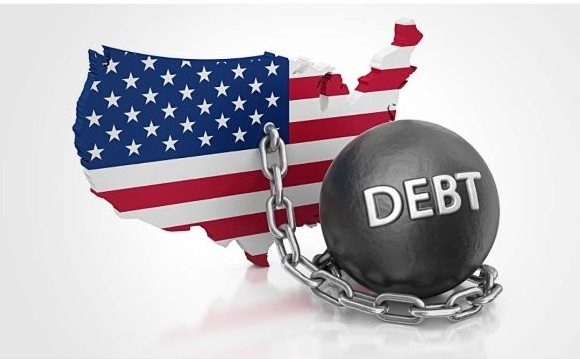
The global economy is slowing despite U.S. fiscal stimulus. American private debt is alarming
The U.S. economic system is not able to withstand a recession without suffering a colossal wave of defaults on private debt and the resulting economic depression.
by Maurizio Novelli, manager of the Lemanik Global Strategy Fund
The global economy confirms the worsening slowdown phase despite the steady and significant fiscal stimulus implemented both before and after the events of 2020. The global economic environment is preparing to suffer the dangerous combined effect of a financial cycle breakdown and a breakdown in the growth drivers that have led the past twenty years.
In an effort to counter these breakdowns, the United States has aggressively pushed fiscal policy, which has become the main factor supporting the economic cycle. The main problem is that the policies implemented have been aimed at trying to sustain a model of development in crisis and no longer sustainable, rather than reforming it. It is therefore clear that the monetary and fiscal policies implemented over the past 15 years have not solved the structural problems, but have instead made them worse, first pushing the global economy into the private debt trap and now into the public debt one. Today, the structural macroeconomic problems weighing on the cycle can be summed up in the following points.
1) A demographic crisis has begun, coinciding with the slowdown in the growth impetus provided by the Baby Boomers generation. Growth up to 2000/2003, driven by consumption supported by income rather than by debt, gave way to growth sustained by consumption fueled by private debt. Demand financed by debt reached 20% of U.S. consumption.
2) The erosion of real incomes after the 2001 crisis, intensified by production offshoring to China, gave rise to a growth model that strongly favored the corporate sector. Companies benefited from low production costs, contained wage pressure, low interest rates and almost zero taxes. The fall in purchasing power was therefore offset by debt. The debt cycle was concentrated in 2004-2008 in Real Estate and from 2010 to the present in consumer credit
3) Starting in 2005, the global economy benefited from China’s extraordinary urbanization and industrial development. This event, which can no longer be repeated, was one of the main drivers of global growth and began to enter crisis with the breakdown of the real estate sector and with the 2020 pandemic.
4) The 2020 pandemic hit the American and Chinese economies at the peak of their leverage based on speculative credit, sustained for more than 15 years of QE. The United States is particularly vulnerable in some segments of private speculative debt (Private Equity, Venture Capital, Private Credit and Shadow Banking in general), and the Chinese in the Real Estate sector. U.S. fiscal interventions have so far contained the situation, but their intensity only highlights the scale of the problem and is not sustainable.
The geopolitical context has deteriorated to such an extent that it calls into question the commercial, monetary and economic balances on which the global economic order defined at Bretton Woods was based. In parallel with these macroeconomic problems, there is the risk of a concurrent breakdown of the financial cycle that has supported financed consumption, funded Chinese Real Estate, channeled substantial resources into the illiquid sector of the Shadow Banking System and swollen the amount of speculative credit in the system. The financial cycle that supported these sectors began after 2010 and was characterized by:
- more than a decade of expansive Quantitative Easing monetary policy;
- repeated and systematic rescue interventions in favor of the financial sector (the 2018 Repo market crisis, the 2020 Covid crisis, the 2023 U.S. banking crisis). Despite public and monetary support, the financial sector has always shown a high degree of vulnerability;
- rate hikes, which in conjunction with the inflationary crisis of 2022 never drained excess liquidity and continued to prop up speculative bubbles and the vulnerability of the financial system. The FED has always provided liquidity injections into the system through a significant increase in bank reserves and the use of liquidity facilities. The reduction in the FED’s balance sheet was therefore offset by banks’ purchases of government bonds, financed by the injection of excess reserves by the FED. QE, direct or indirect, has essentially never stopped.
The global financial cycle is entering crisis because the boom in private debt, sustained by more than a decade of QE, has produced a colossal allocation of risk capital to no-longer-profitable investments (Misallocation) in many sectors of the economy (Private Equity, Venture Capital, Commercial Real Estate, Chinese Real Estate, etc.). The new emerging growth drivers (AI and the energy transition) are currently not profitable and are adding huge amounts of investment to projects that, at the moment, destroy capital and generate income for only a very small number of companies, increasing the concentration of financial risk as well as the misallocation of capital in the global economy. The green transition has had a devastating impact on the global auto sector, while investments in datacenters for the implementation of AI are devouring capital and currently generating no income. These investments also require high energy intensity, which increases energy costs for other sectors of the economy. The monetary multiplier, despite the substantial liquidity still present in the system, is therefore becoming less and less effective on the real economy and is providing fuel only to financial speculative bubbles.
To offset the breakdown of the monetary multiplier, policymakers have moved with aggressive expansionary fiscal policies. These policies initially countered the breakdown of the financial cycle (or private debt cycle), but the fiscal multiplier is now also losing traction, to the point that the U.S. economy needs ever more debt to grow by an average of only 1.5%-1.8%. The Chinese economy is also feeling the impact of the Balance Sheet Recession in the real estate sector, and is trying to counter deleverage with a GDP deficit of 6% a year. The scale of the budget deficits in China and the United States is closely linked to the size of the economy’s structural problem. Western economies as well, especially Europe and the United States, like China, have begun to "politicize" macroeconomic data in order not to admit the crisis situation.
Because the more-than-decade-long financial cycle has inflated systemic speculative bubbles in almost every segment of the financial market (Equity, Private Equity, Crypto, Speculative Credit, etc.), the system is highly vulnerable and is not able to withstand a recession without suffering a colossal wave of defaults on private debt and the resulting economic depression. This is the main reason why fiscal policies cannot be stopped and the world’s Central Bank (the FED) must be controlled by politics in order to introduce debt monetization.
Speculative credit in the American economy is underestimated at around 12 trillion USD, more or less 50% of GDP. Part of this debt was not solvent with interest rates at zero, is not solvent with rates at 5% and will not be solvent if rates return to zero. In reality, the only possible solution would be to begin restructuring the economic model with:
- expansionary fiscal policies aimed exclusively at increasing real incomes in order to make growth less dependent on financed demand and reduce the private sector’s leverage.
- restrictive fiscal policies for the Corporate sector, which operates in a tax-free regime, to finance expansionary fiscal policies.
- selective management of insolvent credit to avoid disorderly deleverage.
- taxation of buybacks and tax relief for real investment in the economy.
Introduce declining capital gains in proportion to the holding period of an investment in order to clean up markets from excess short-term speculation and encourage medium- to long-term investments (Tobin Tax). The problem is that at present no one has the courage to implement such economic policies, because they would be negative for the financial sector and for the U.S. stock market. So, in order to defend the speculative bubbles, the model that has led us into the debt trap is being perpetuated with new debt, and reforms will only become justifiable after a systemic crisis. However, because systemic risks are becoming ever greater, the United States has begun preparing for a crisis event by introducing emergency rules on blocking foreign capital outflows, a potential closure of dollar swap lines, government control of the FED, control of the yield curve, and the deployment of the National Guard in major American cities.
Tags
Related articles



Newsletter
The Patrimoni & Finanza newsletter
A considered selection of analysis on economy, Real Estate and wealth
The subscription service is not connected yet: no address is stored