

Investing in wartime: leave emotions aside and embrace a medium- to long-term approach
What strategies should be adopted and which financial instruments should be chosen in times of war? Here’s how to diversify your portfolio to defend against the volatility generated by an extended geopolitical crisis.
By Francesco Megna, head of sales at a major bank and expert in finance and economics
The ongoing conflicts around the world and the resulting geopolitical crisis are also affecting financial markets. It is commonly believed that, in times of crisis and uncertainty, it is better to set aside unused money and avoid making investment decisions, but this approach can prove harmful: capital left sitting in current accounts tends to lose value significantly as a result of inflation. Investing even in wartime, therefore, could be the most sensible choice. It is important, however, to understand how to direct one’s investments in particularly difficult moments, and above all which strategies to adopt, which financial instruments to choose and how to diversify your portfolio to defend against volatility.
To gain greater awareness and let rationality prevail over irrational emotions (which very often dominate investment choices and cause glaring mistakes), it is worth answering one question: what is the impact of war on financial markets? History teaches that in the short term world conflicts have decidedly negative consequences for investments, but are then followed by very rapid recoveries. This means that if money is viewed with a time horizon of at least the medium term, the impact of a war on returns is not significant. If we look at the war in Ukraine, since 23.2.2022 the trend of the main global markets has seen the DJ index +38%, the Nasdaq +71%, the FTSE MIB +63%, London +22%, the Dax +59%, Paris +15%, China -2%, Tokyo +69%. If we then consider the two World Wars and the war in Vietnam, we find that the DJ posted a sharp initial fall (around -30%), but then recorded significant gains, averaging about +8%, immediately afterward.
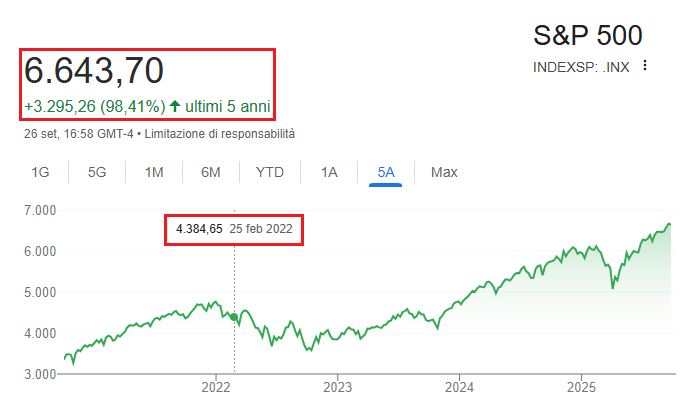
If we assume we invested $10,000 in the S&P 500 between 2003 and 2022, by the end of the twenty-year period we would have $65,000, that is, about six times the original investment. And over these 20 years, everything happened (pandemic included). Those who were overwhelmed by fear, trying to anticipate the financial markets by selling before a decline and buying before a rise, missed ten of the best performance days after the conflict and, over the same twenty years, made just under $30,000, less than half of what those who did not give in to panic and left their investments untouched made.
Normally, the outbreak of an armed conflict generates higher inflation, a weakening of the currency and sharp stock market declines, as well as negative performance for the dollar and commodities. In these periods, there are traditionally those who invest in defence stocks or in so-called safe-haven assets, such as gold. However, the winning strategy for protecting oneself from volatility is to adopt a medium- to long-term approach, remain consistent with one’s original plans and planning, and not let oneself be overwhelmed by market restlessness. Certainly, in these phases of market turbulence, it may be advisable to invest in gold - a classic safe-haven asset uncorrelated with the performance of shares and bonds and not dependent on political events - but not only that. ETFs, for example, are a very sound managed savings tool because they replicate specific stock market indices, are low risk and ensure attractive returns over time, thanks also to lower management fees.
The golden rule, even (and especially) in wartime, remains to have a well-diversified investment portfolio across the chosen asset classes and well balanced, keeping one’s investment objectives unchanged over the medium- to long term and adopting an investment strategy that diversifies asset classes and management styles to balance risk and return. With diversification, in fact, one adapts quickly to market cycles, contains the overall portfolio volatility and increases the chances of achieving satisfactory results from one’s investments.
With the right guidance, it is also useful to monitor events and adjust the portfolio accordingly, in order to seize incoming opportunities. To do this, it is important to have a decent amount of liquidity available, so as to be able to respond quickly and take advantage of market opportunities, or to deal with emergencies (family, personal, professional, etc.) during critical periods, when investments are worth less and it is not advisable to sell even partially. Investing in government bonds issued by solid countries is also considered a good strategy during crises, although the expected return is rather modest: long maturities should be avoided to limit the volatility of the security.
Another tool to use in wartime and in periods of great volatility is systematic investment plans in managed savings (funds and SICAVs), which help mitigate market swings and take advantage of sudden drops thanks to automatic transfers from the current account. In practice, PACs (capital accumulation plans) make it possible to invest small monthly amounts even in the worst market periods (such as those following the outbreak of an armed conflict), allowing one to accumulate, at significantly lower prices, those units of equity funds which, after the most acute phase of a geopolitical crisis, quickly recover value and make it possible to realise capital gains much sooner than an investment made in a single lump sum.
This article was produced in collaboration with Banking People
Tags
Related articles



Newsletter
The Patrimoni & Finanza newsletter
A considered selection of analysis on economy, Real Estate and wealth
The subscription service is not connected yet: no address is stored