
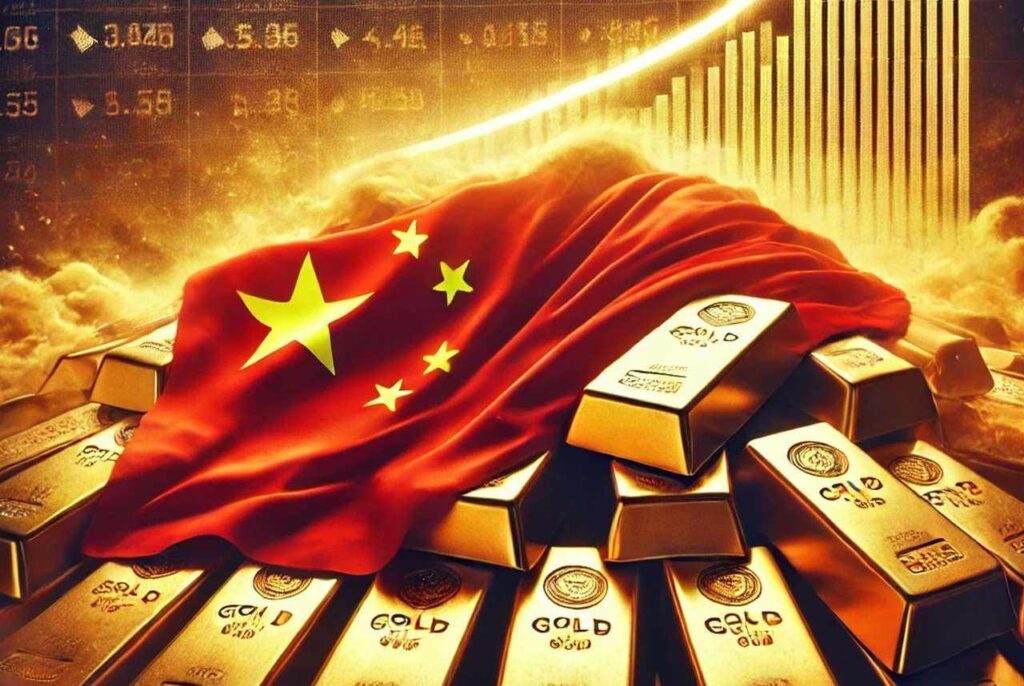
While “financial deglobalization” is already underway, the gold market is in China’s hands
The major investment houses are the main financiers of the leverage in the U.S. system. Gold is the only asset class that has escaped U.S. control and is now in the hands of Chinese policy makers.
by Maurizio Novelli, manager of Lemanik Global strategy fund
The election result in Japan saw the victory of another policy maker in favor of increasing public spending, while asking that interest rates be kept where they are (0.5%). It is more or less the same policy pursued by the Trump administration, which is pushing an expansionary fiscal policy alongside lower interest rates. The CEO of Open AI, Sam Altman, when pressed by a financial journalist about the prospective profitability of the massive investments in artificial intelligence, replied: "profit is not currently in my top ten priorities".
We are therefore about to enter a financial environment in which some policy makers are asking for ever more capital to finance the expansion of debt, while at the same time wanting to impose lower compensation on lenders. Meanwhile, we are seeing a growing demand for capital to finance technological innovation without any outlook on the return of invested capital. At this point, the only profitability you can try to extract from a world that works this way is that produced by speculative bubbles, where everyone tries to join the game. The problem is that many are convinced this obviously cannot last very long, but they believe it can still work for a while, inflate the speculative bubbles further and then end in a crisis, where everyone is still convinced they can get out before the event.
And so, after 14 years of zero rates and QE, we have entered a new phase of "financial repression", which will lead the world’s main economies into a war for capital control to support systems in growing "distress". Since no one, in a global market, can force their lenders to increase debt financing at returns set by the debtor itself, a potential conflict is looming over control of the capital needed to finance these endless reflationary policies that produce (asphyxiating) growth financed by (explosive) debt. The risk of a potential break in the global capitalist system is becoming increasingly real and "State Capitalism" will inevitably take its place.
This is giving rise to the idea of a system in which governments will somehow force savings to be directed in a top-down manner toward domestic securities and domestic markets, with real returns of zero. The first stage of this shift is the introduction of tariffs, aimed at moving manufacturing production from one country to another; the second stage is the introduction of disincentives to invest abroad and the repatriation of the savings that finance the growth and debt of a competitor. This mechanism will lead to the collapse of the current global monetary system based on the Dollar and will trigger the repatriation of exported capital to finance constantly expansionary local fiscal policies.

This is also why Gold is rising. Banks will be forced to subscribe to government bonds (indirect QE), pension funds will have to invest more and more in domestic assets and mutual funds will come under political pressure to invest where governments want them to. These mechanisms are already being actively discussed in the UK and, in fact, are already in place in the United States, where the major investment houses are now the main financiers of the U.S. system’s financial leverage. The problem is that the United States depends on foreign savings gathered by American fund companies and could be exposed to a outflow of such financing. For this reason, the Trump administration has laws at its disposal that allow foreign capital to be blocked from leaving on grounds of "national security".
In China, the repatriation of capital has already taken place alongside the closure of Chinese investments by many Western countries, while capital flows into China have effectively been at a standstill for at least three years, since the Biden administration threatened sanctions against anyone investing in China and triggered an outflow of capital from the American market in Hong Kong. The large Japanese institutions, which poured trillions into international markets during the years of zero rates in Japan, are beginning to consider allocating to domestic assets, driven by higher interest rates and political pressure that cannot be ignored. Financial deglobalization is the consequence of industrial deglobalization and will be a defining feature of the years ahead.
The United States is certainly the country worst placed to face a phenomenon of capital repatriation, given that the value of U.S. financial assets (at all-time highs) is supported mainly by the flow of foreign savings and not by American savings. At the same time, the (understated) $13 trillion in speculative credit issued during the excesses of QE have begun to surface in some bank balance sheets, triggering panic selling in the sector and casting shadows of contagion, as happened in 2007 with Bear Stearn. Listed Private Equity companies are on average down 15%-20% since the start of the year. The BlackStone Tech & Private Equity Trust fund is down 70% from its 2022 highs, the BlackStone Senior Loans fund is down about 11% from its 2022 peak, the BlackStone Secured Lending Fund is down 25% since February 25, the Apollo Commercial Real Estate Finance fund is down 50% from its 2020 peaks, the BlackStone GSO Long Short Credit Income fund is -31% from its 2020 highs and KKR Real Estate Finance is down 63% from its 2022 peak.
Meanwhile, U.S. banks continue to provide "life support" to the Shadow Banking System, with loans rising to 1.2 trillion USD (+400bn in the last quarter alone). Nothing is known about the value of the collateral pledged against these loans, but it is reasonable to think that the credit extended, in many cases, is backed by assets that have lost value over the last 3/4 years. In addition, it is fair to ask some questions about the loan losses reported by U.S. banks. How is it that, with record default rates of 13% in Commercial Real Estate, Non Performing Loans (NPL) in that sector are only 1%? Regional banks have exposure to CRE equal to 260% of Tier 1; why is the KBW bank index at all-time highs in this situation? Delinquencies on consumer credit are at their highest level since 2010; why are banks not showing losses in this segment of lending?
Nothing seems more credible in a system that publishes inflated macro data and balance sheets of dubious credibility, all in order to keep feeding the financial bubbles that dangerously hover over our heads and hope that everything can be resolved without damage. The only way to prevent this situation from ending in an epic systemic crisis is to pursue fiscal support and the nationalization of the financial system. If anyone has not yet noticed, rates in the Treasuries market are in effect controlled by the Treasury Department (YCC). Any news fails to move the level of ten-year yields away from the 4.0% area, and the political objective is to bring them down to at least 3%. Banks must continue to publish positive balance sheets and not increase credit loss provisions so as not to make it seem that there could be problems.
In this context, the system is already effectively nationalized and "politicized" macro data help keep the situation under control, since talking about the risk of recession in a phase of total "statistical suppression of the macroeconomic cycle" makes no sense at all. Gold is probably the only asset class that has escaped control and is now in the hands of Chinese policy makers. The hypotheses of a revaluation of U.S. gold reserves have evaporated and Treasury Secretary Bessent has said that the United States does not want to revalue them. Very strange for a country that would need to revalue an asset that could reduce the stock of net public debt (total public debt minus available assets). The truth is that the United States probably sold its gold reserves years ago and always thought it could buy them back at a lower price because it was manipulating the Gold market. The problem is that it did not reckon with China, which has accumulated Gold and now controls the physical market.
It is extremely likely that the gold reserves recently accumulated by Central Banks will play a role in the restructuring of the international monetary system when the United States can no longer hold up and hide the crisis in the Shadow Banking system, and are dragged into the usual financial crisis. But it is not only the Chinese who are buying Gold; the ECB now has 500 billion euros in Gold in its foreign reserves. Once the FED confirms the opening of a downward phase in rates and a "shadow governor" is appointed alongside Powell to support him until the end of his term, the Dollar will enter another bearish phase, with a target of 1.40 against the euro within a maximum of 18 months.
Tags
Related articles

Newsletter
The Patrimoni & Finanza newsletter
A considered selection of analysis on economy, Real Estate and wealth
The subscription service is not connected yet: no address is stored