
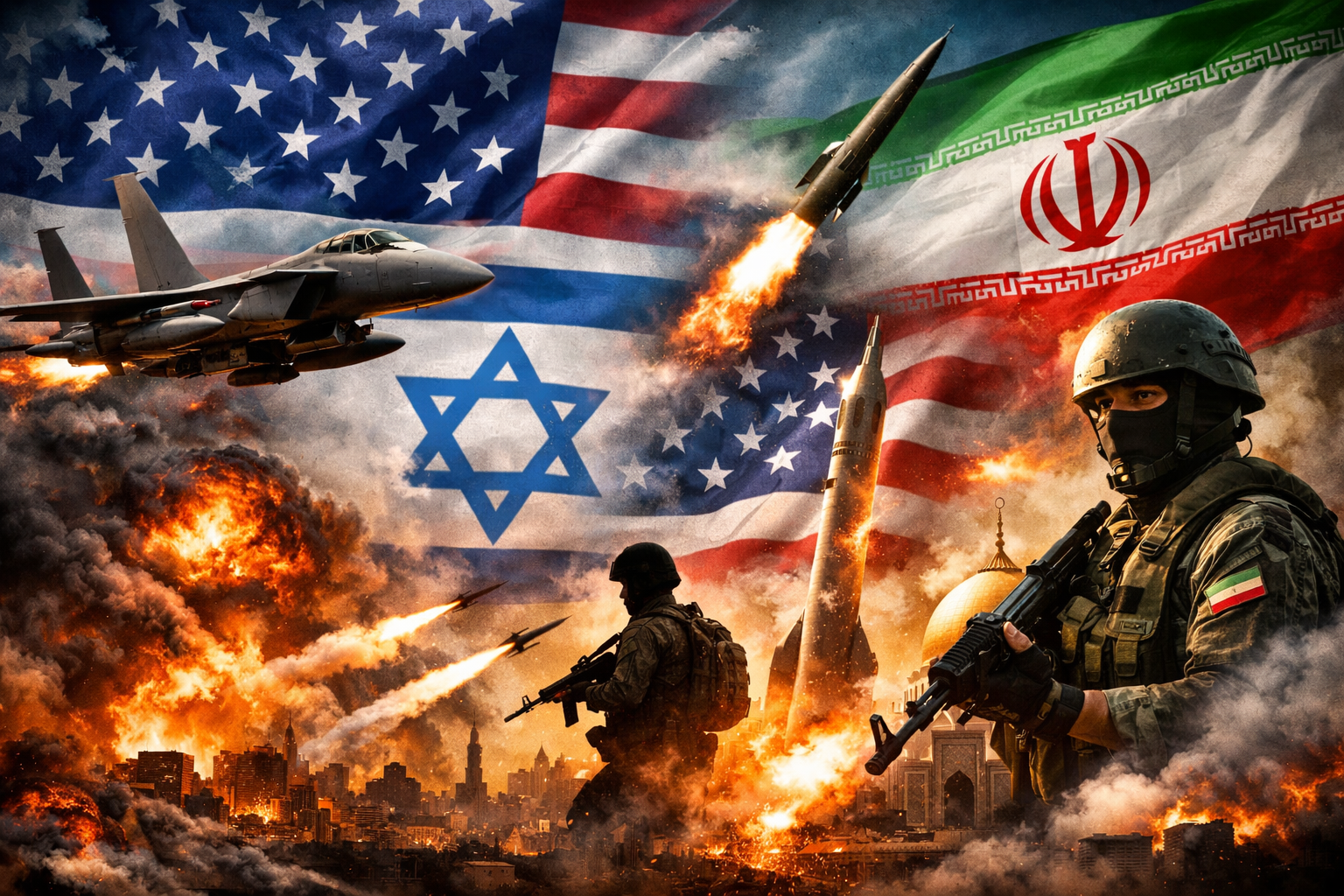
The crisis between America, Israel and Iran: a new conflict to halt the collapse of the Dollar Standard
War with Iran is a contest that concerns not only the Middle East, but the entire balance of the international economic system built at Bretton Woods.
by Valerio Giunta, CEO of Startup Italia and Founder of Banking People
When the United States decided to attack Iran, the official explanation was relatively simple: to prevent an imminent threat, since according to the White House Iran was moving closer to the nuclear bomb. This account was questioned almost immediately: the Director General of the International Atomic Energy Agency, Rafael Grossi, said there is no evidence of a systematic Iranian programme to build nuclear weapons. Iran has indeed enriched uranium to 60%, but, as Grossi made clear, the IAEA has not identified any structured programme for the production of nuclear weapons.
Secretary of State Marco Rubio helped fuel serious doubts about the official narrative, saying “We knew that, if Iran were attacked, it would strike us immediately. And we would not have stood there taking the hit”. A phrase that points to a different dynamic: not an attack to prevent an Iranian act of aggression, but the awareness that Tehran would respond only after military action. Meanwhile, within just a few days, the justifications for the intervention changed several times. As analyst Daniel De Petris noted, the rationale shifted from destroying the nuclear programme to reducing Iranian missile capability, and then to preventing a threat against American troops. According to Politico, several days after the start of the conflict the administration still had not been able to clearly define its strategic objectives in the war.
If the conflict is viewed within a global geopolitical framework, the crisis with Iran takes on a very different meaning. Tehran occupies a fundamentally strategic position between the Persian Gulf, Central Asia and the Mediterranean. The country is a key hub for Eurasian energy routes and trade routes and is set to become one of the main nodes of China’s Belt and Road Initiative. In recent years Iran and China have strengthened their economic cooperation through long-term energy and infrastructure agreements, and for Washington this axis represents a strategic threat: weakening Iran also means limiting China’s geopolitical expansion in the Middle East, disrupting trade routes and making the purchase of oil more expensive.
But the problem is not only geopolitical. It is also financial. In fact, the international economic system built after the Second World War rests on the centrality of the dollar, the so-called Dollar Standard. For decades global trade – and energy trade in particular – has been priced almost entirely in the American currency. In recent years this balance has begun to show cracks. According to several economic analyses, the growing use of the dollar as a geopolitical sanction tool is pushing many countries to look for alternatives. Several states are reducing their dependence on the American currency in international trade and central bank reserves ("de-dollarization"). According to this analysis, the dollar’s share of global central bank reserves has fallen from 71% in the early 2000s to around 57%.
For the United States this represents an existential threat. Global demand for dollars is in fact one of the factors that allows Washington to sustain an enormous public debt (now 40 trillion dollars), financing its deficits through the issuance of securities denominated in its own currency. But in recent years Iran has begun selling part of its oil using alternative currencies, especially in economic relations with China. Then, in 2023, the agreement between China and Saudi Arabia was announced, allowing Beijing to progressively pay for Saudi oil in Yuan rather than in dollars. A sensational piece of news that clearly set off alarm bells in Washington. Trump, in fact, immediately after his re-election, moved at once to try to build a diplomatic buffer against this.
This trend, which was consolidating, accelerates the erosion of the dollar’s centrality. And it is precisely in this context that many analysts place the crisis with Iran. One unavoidable question remains, however: why this war right now. In the United States, several internal political pressures have built up in recent months. One of the most sensitive concerns the Epstein files, the vast archive of documents linked to the case of financier Jeffrey Epstein. The handling of the release of the documents has sparked controversy and accusations of a lack of transparency, with several members of Congress calling for further investigations.
At the same time, the American economy is showing signs of growing fragility. Several indicators suggest a slowdown in the labour market and economic growth. February data show a significant drop in employment and a slowdown in sales across several sectors of the economy. On top of that, there are signs of tension in the financial system. Over the past few months, major difficulties have emerged in the private credit market. For example, yesterday BlackRock began limiting withdrawals after a wave of redemption requests, a sign that it could be facing liquidity problems. In this context, an international crisis has a strong political function: shifting public attention towards an external threat.
What could happen now? The consequences of the war are spreading well beyond the Middle East. One of the most immediate effects concerns energy prices, in the sense that a lasting rise in oil and gas has especially heavy consequences for Europe, which is heavily dependent on energy imports. In fact, after breaking off energy ties with Russia, Europe drastically increased imports of liquefied natural gas from the United States and now (barring a rapprochement with Russia) will have to do so even more to avoid returning to the situation it found itself in at the beginning of the 1970s. This means that higher energy prices tend to benefit American producers while penalising European industry, which is already under intense competitive pressure.
Historically, energy crises tend to produce rebalancing in the trade balance between the United States and Europe, shifting a significant share of economic resources towards energy producers (the USA is the world’s leading oil producer). After all, it would not be the first time that a Middle Eastern crisis has produced this kind of effect in a global system heavily dependent on energy. A significant historical precedent is the 1973 Yom Kippur War; it was precisely after that war that the petrodollar system emerged, that is, the mechanism through which world oil was gradually traded almost exclusively in dollars, and the energy crisis that followed that conflict contributed to profoundly reshaping the economic balance between Europe and the United States.
In this context comes what was said by the political commentator and former Trump supporter Tucker Carlson, according to whom some attacks on oil infrastructure attributed to Iran may have been the result of clandestine operations carried out by Mossad agents. Tehran has distanced itself from several sabotages against energy facilities, denying any direct involvement.
But there is also another possible strategic consequence of the war. According to philosopher and political analyst Andrea Zhok, the attack on Iran risks producing a paradoxical effect: strengthening precisely those more radical components of the Iranian political system that the West says it wants to weaken. Faced with an external threat perceived as existential, societies tend to close ranks around their institutions and power structures. In other words, an open conflict risks consolidating Iran’s internal political order, so much so that the most likely outcome of this new front of war is the so-called "quagmire". And that is precisely why control of energy markets continues to be one of the central elements of global geopolitical competition.
There is also another strategic dimension to the crisis. In recent years Russia has strengthened its energy cooperation with China, selling oil and gas at particularly competitive prices. For Washington, this convergence between Moscow and Beijing is one of the main strategic problems of the new world order, so a general rise in energy prices can only reduce the competitive advantage China derives from access to low-cost Russian energy up to now. But the most important geopolitical consequence concerns Asia, where the real strategic theatre of competition between the United States and China remains Taiwan. If Washington were trapped in a long conflict in the Middle East, the American ability to concentrate military resources in the Pacific could only diminish. This creates a favourable strategic window for Beijing: not necessarily for an immediate invasion of the island, but for more gradual strategies such as a naval blockade or growing military pressure in the Taiwan Strait.
In this scenario, the war with Iran is one front in a much broader global competition. A competition that concerns not only the Middle East, but the entire balance of the international system built at Bretton Woods. And that is perhaps the most delicate point of the current crisis, because if the petrodollar system and the centrality of the dollar were to come truly into question, the consequences would concern not only American foreign politics, but the very architecture of the global economy. The war with Iran, like the one in Ukraine, is not just a local crisis, but one of the symptoms of the changing of an international order that is slowly reaching the end of its historical cycle.
Tags
Related articles

Newsletter
The Patrimoni & Finanza newsletter
A considered selection of analysis on economy, Real Estate and wealth
The subscription service is not connected yet: no address is stored