
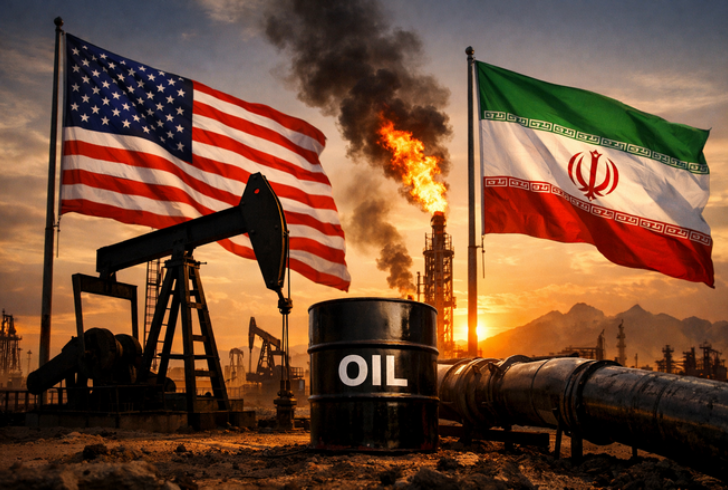
Trump vs Iran: what if the oil crisis were not an "accident"? An analysis of a possible strategy
For Trump, a prolonged energy crisis could be a sort of indirect tariff, a way to weaken rival economies without introducing new trade barriers.
by Valerio Giunta, CEO of Startup Italia and Founder of Banking People
When the Donald Trump administration decided to strike Iran, the choice was not unanimous within its own political camp. In fact, according to several reconstructions and foreign policy analyses, various figures in the “America First” camp had strongly voiced opposition to a military escalation with Tehran. Among the more cautious voices were Vice President JD Vance, in favor of avoiding new conflicts in the Middle East, and several economic advisers at the White House, concerned about the possible consequences of a global energy crisis.
Parts of the American military and strategic community also urged caution. Analysts and commentators such as Daniel De Petris, or the geopolitical analyst Trita Parsi, argued that a direct confrontation with Iran would have destabilized the Middle East, with the likely closure of the Strait of Hormuz. Even General Caine, Chairman of the Joint Chiefs of Staff of the United States (the highest military rank in the USA and appointed by Trump himself), had warned that a war with Iran would entail strategic risks that would be very hard to control. Trump nevertheless decided to move ahead, ignoring the most prudent advice and—so it is said—underestimating the economic consequences of the crisis, with the result that today things are not going as expected.
However, it is fair to ask whether the resulting oil crisis from this war is not an unforeseen effect, as many analysts argue, but rather one of the most predictable—and potentially most useful—outcomes sought by Trump. It would not be the first time, in fact, that a global energy crisis heavily alters the world’s economic and geopolitical balance. In 1973, after the Yom Kippur War, the oil shock paved the way for the birth of the petrodollar system, strengthening the role of the dollar in global trade. In recent years, the United States has been going through a very complex economic and political phase, with the American public debt having now reached 40 trillion dollars, while its entire economic system—including households, businesses, and the financial sector—operates with very high levels of debt (31 trillion in private debt). At the same time, American economic hegemony is no longer unchallenged, because two major industrial blocs are competing ever more openly with Washington: China, now a global manufacturing power, and Europe, still one of the planet’s main industrial hubs.
The competition is above all industrial, technological, and commercial. As a result, the Dollar Standard system is under pressure. Since the postwar period, global trade—and especially energy trade—has been dominated by the American currency. This has allowed the United States to sustain enormous deficits and growing debt thanks to global demand for dollars, widely regarded as a stable reserve currency. Over the past few years, however, something has begun to crack: more and more countries (the so-called BRICS) are seeking to reduce their dependence on the dollar, and many central banks are increasing their gold reserves, with gold reaching record prices over the past year precisely as an alternative safe-haven asset. This does not mean that the dollar is about to be replaced, but it does show that the international monetary order is slowly changing.
Meanwhile Xi Jinping has made public, in his main theoretical newspaper Qiushi, a 2024 statement of his: “a powerful currency (the yuan, widely used in international trade, investment and foreign exchange markets, with the status of a global reserve currency.” (Bloomberg). In this context, the energy issue takes on strategic significance. Over the past fifteen years, the United States has carried out a radical overhaul of its energy system thanks to the shale oil revolution, which has made it the world’s largest oil producer. This completely changes the logic of oil crises: in the 1970s, the United States was heavily dependent on imported oil, and had to keep the price of oil high to make shale extraction viable for domestic producers; today the situation is different, because the United States has become one of the main producers and exporters of energy. It follows that a prolonged global oil crisis does not affect everyone in the same way, but hits especially the energy-importing economies: Europe, China and Japan.
To this must be added another factor. Recent openings in Venezuela’s energy sector have allowed American companies to gain access to a significant share of the country’s enormous oil reserves, the largest in the world, further strengthening the energy security of the United States. In other words, while many countries suffer heavily from a prolonged oil crisis, the United States is among the few global actors able to manage it without serious domestic consequences. The oil crisis thus becomes a valid alternative to the global tariff policy now blocked by the United States Senate. In fact, if the price of oil remains steadily high, the effects on the countries that depend on it are immediate: industrial costs rise, inflation increases, and the competitiveness of their economies worsens.
Europe, China and Japan are among the economies most vulnerable to this kind of shock. In this sense, a prolonged global energy crisis is effectively a form of indirect tariff, a way to raise competitors’ production costs without introducing new tariff barriers. There is also another possible effect. A rise in oil prices also strengthens Russia, a major energy exporter, and this could even open up new geopolitical scenarios, since it could reduce the "embrace" between Moscow and Beijing. After all, history shows that oil crises are never just energy crises.
Naturally, there is no proof that the oil crisis was planned and carried out in a "surgical" manner, but one thing is certain: when you strike a heavily armed country like Iran, with a highly cohesive society, it should be easy to foresee that the Strait of Hormuz will be blocked, becoming the most fragile point in the world energy system; it follows that the oil crisis cannot simply be regarded as an “accident”. If that were the case, and if the energy crisis were to last a long time (as in the 1970s), what can we Europeans do to deal with it?
Tags
Related articles

Newsletter
The Patrimoni & Finanza newsletter
A considered selection of analysis on economy, Real Estate and wealth
The subscription service is not connected yet: no address is stored