
Jaguar’s roaring 1950s
From the C-Type to the D-Type, five victories at Le Mans built a legacy of innovation and prestige that still sets the marque and its collector cars apart today
A passion for racing belongs to the very origins of Jaguar. For William Lyons, proving the value of his cars on the track also meant winning trust in the marketplace. In the 1950s, that conviction became an industrial strategy capable of bringing together performance, beauty and experimentation. The 24 Hours of Le Mans offered a particularly severe test: speed alone was not enough, the cars had to endure, use fuel intelligently and allow the drivers to keep up a high pace even through the night. From that challenge came the C-Type and the D-Type, protagonists of five victories between 1951 and 1957 and of a historical legacy that goes far beyond a simple list of results.
From road car to racing machine
The private XK120s entered at Le Mans in 1950 showed that the brand’s technical base could also be competitive in the great French race. To tackle it with any hopes of victory, however, a car conceived expressly for racing was needed. The future C-Type, initially known as the XK120C, retained its link with the road car’s engine, but rethought its structure and bodywork. Bill Heynes led the technical work; Malcolm Sayer brought an aerodynamic approach honed in the aviation world. The tubular chassis and aluminium kept weight down, while the shapes were designed to cut through the air with less resistance. Elegance came from function, without losing expressive force.
The first victory came in 1951 with Peter Walker and Peter Whitehead. Winning on debut immediately gave Lyons’s choice credibility and turned the race into an international showcase. Yet it was not the start of an unbroken progression. In 1952, a bodywork modification intended to gain speed compromised cooling and the factory cars retired. That defeat recalls an essential feature of technical development: improving one parameter can weaken another. In competitions of endurance, efficiency is not the same as top speed alone, but rather the balance of the entire design.
The advantage of disc brakes
In 1953 the C-Type returned to the fore with Tony Rolt and Duncan Hamilton, ahead of the other Jaguar driven by Stirling Moss and Peter Walker. The result also rewarded the development of disc brakes, carried out with Dunlop and tested in racing. The ability to slow more consistently offered a repeatable advantage at every corner, particularly important when conventional systems were under hours of strain. The victory thus showed that an innovation less spectacular than the engine could alter the balance of power between rivals. The circuit became a laboratory whose solutions would influence the road car.
The appeal of the C-Type also depends on this relationship between spareness and invention. The bodywork does not hide the mechanics beneath ornamental language: it organises them into a compact, recognisable and functional form. In the story of motor sport, the car represents the moment when Jaguar showed it could take on manufacturers with an established reputation without imitating them. The later D-Type would carry that identity even further, turning the relationship between structure, aerodynamics and stability into a new racing architecture.
The D-Type and the lesson of aviation
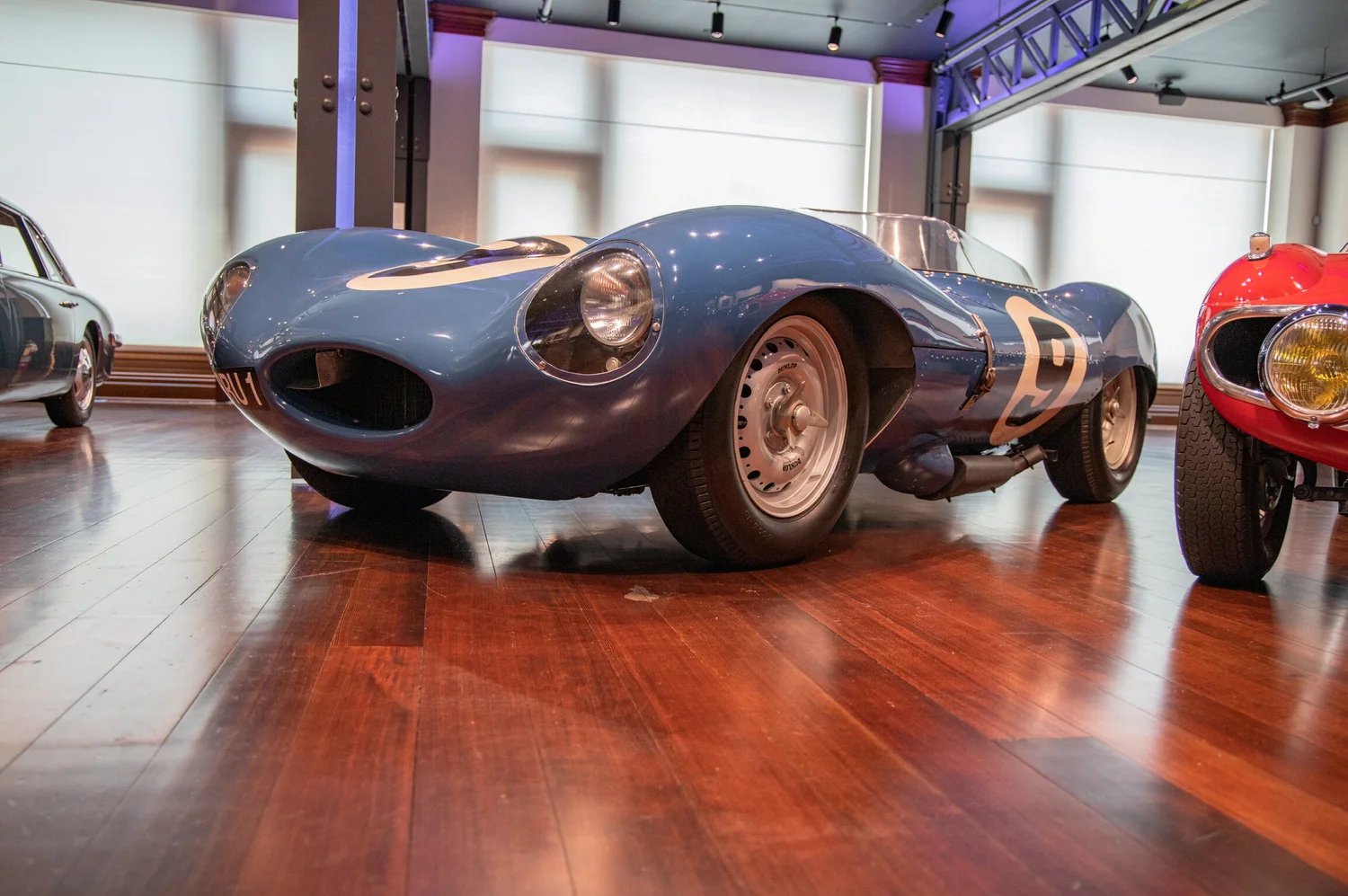
Introduced in racing in 1954, the D-Type introduced a central monocoque structure and a line destined to become unmistakable. The fin behind the driver, in the configurations that adopted it, visually translated the search for stability at high speeds. The project was not simply a more powerful C-Type: it reorganised the construction of the car around a greater integration of form and engineering. In its first showdown at Le Mans, Rolt and Hamilton finished second behind the Ferrari of José Froilán González and Maurice Trintignant. The result did not deliver victory, but it showed that the new car already had considerable potential.
The 1955 success, with Mike Hawthorn and Ivor Bueb, remained inseparable from the tragedy that struck that race. The accident involved Pierre Levegh’s Mercedes and caused the death of the driver and numerous spectators. The sequence of events and the responsibility for that tragedy cannot be reduced to a single technical explanation. The sporting result remains in the record books, but it cannot overshadow the human cost of an era in which performance and public protection moved at very different speeds. Safety became an issue impossible to separate from the future of competitions.
Private teams complete the feat
In 1956, Ron Flockhart and Ninian Sanderson won with the D-Type entered by Ecurie Ecosse. The following year the Scottish team returned to victory with Flockhart and Bueb: in 1957 five Jaguars finished in the top six. The strength of the project also made itself felt outside the factory structure, through the expertise and organisational ability of private teams. Ecurie Ecosse was not a lucky outsider, but an essential part of this story. For those who love collecting, even the livery, team and drivers help distinguish one car from another example of the same model.
The season then began to change. Regulations, rivals and industrial priorities reduced the space for cars born to dominate the decade. Their legacy, however, remained in Jaguar’s design culture and in the path that would lead to the E-Type in 1961. In 1956 William Lyons had been knighted: the title of Sir recognised his contribution to British industry. The brand’s prestige no longer stemmed solely from the characteristics of the cars on sale, but from a verifiable history of competition and innovation, capable of spanning generations of enthusiasts.
When history enters the value
A significant moment for collecting took place in Monterey in August 2016, when RM Sotheby’s sold the D-Type XKD 501, a Le Mans winner in 1956, for $21.78 million, fees included. That result concerns an exceptional example and does not constitute a valuation applicable to all D-Types. A collector car’s value is shaped by provenance, originality, documentation, condition and sporting results. The memory of a victory can make a car unique, but it does not eliminate the costs of maintenance, insurance, storage and sale, nor does it guarantee future revaluation.
The roaring Fifties therefore remain a story of ingenuity and passion before they are a story of prices. The C-Type and D-Type show how a company can build prestige through concrete results and how that prestige becomes historical legacy. To collect them is to safeguard objects in which the shape tells the story of designers, drivers and mechanics. The market assigns a value to this heritage; understanding it requires looking beyond the badge and recognising the specific history of each car.
Sources
Original text by Fabio Berardi
“The roaring 1950s” - editorial summary
Jaguar Daimler Heritage Trust
E-Type Evolution
https://www.jaguarheritage.com/event/etype-evolution-exhibition/
ACO
Le Mans historical roll of honour
https://assets.lemans.org/explorer/pdf/courses/2020/24-heures-du-mans/press-kit/statistiques-historiques-fr.pdf
RM Sotheby’s
D-Type XKD 501, Monterey 2016
https://backoffice.rmsothebys.com/auctions/mo16/lots/r190-1955-jaguar-dtype/
Jaguar Heritage
William Lyons
https://www.jaguarheritage.com/jdht/uploads/William-Lyons-Jaguars-Founder-20190225-Francois-Prins.pdf
Tags
Related articles


Newsletter
The Patrimoni & Finanza newsletter
A considered selection of analysis on economy, Real Estate and wealth
P&F Weekly: weekly newsletter, sent in Italian
After you submit, if the address can be subscribed you will receive an email with a link to click: the subscription starts only after the click