
Madrid and Rome — What a prime historic apartment costs
Period buildings, high ceilings and prestigious addresses are part of both capitals. Yet Madrid commands particularly high asking prices in its most exclusive neighbourhoods. Rome can offer lower figures, provided the properties being compared are genuinely similar: a historic-centre address alone is not enough
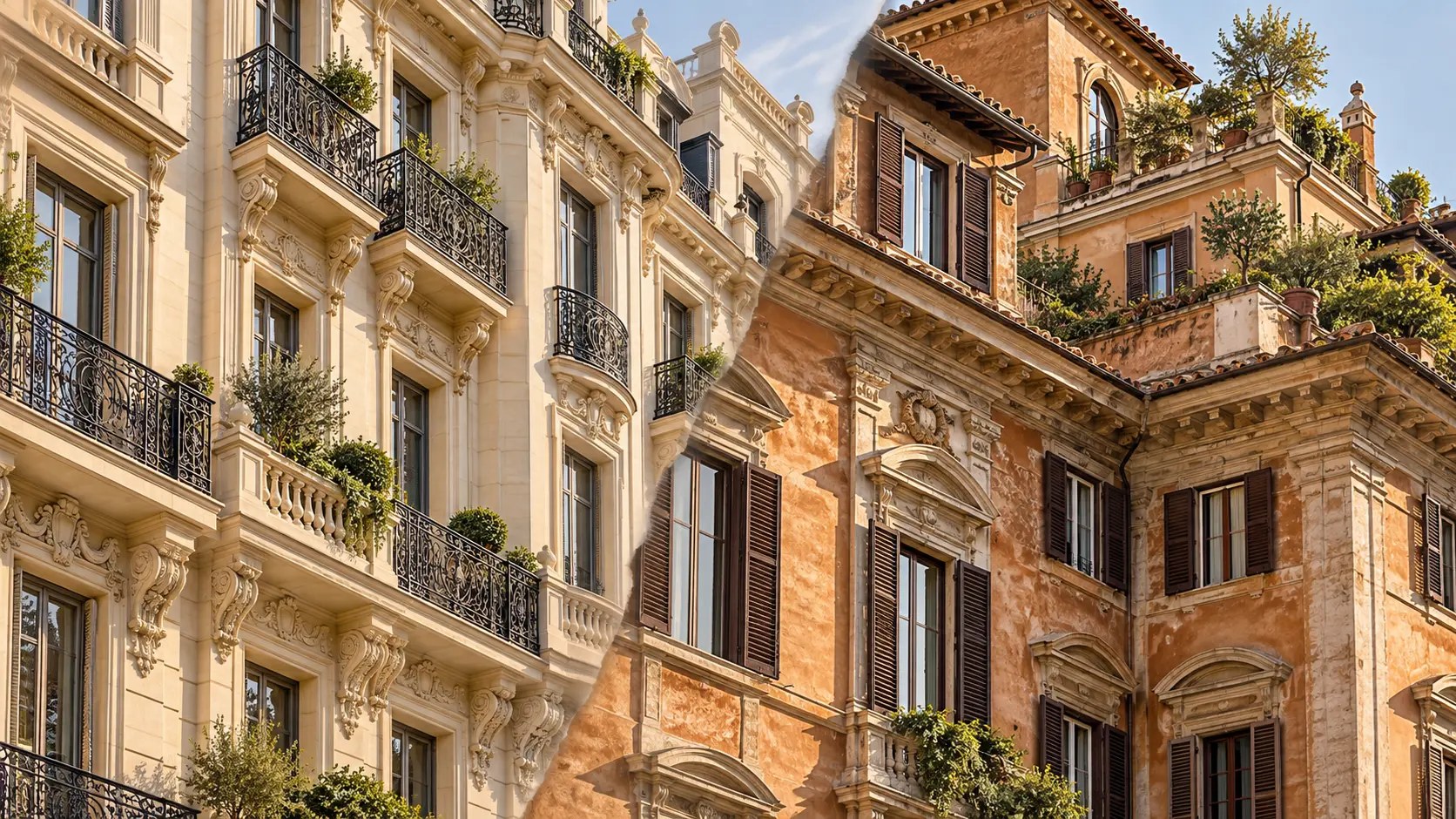
Side-by-side façades of historic buildings with ornate balconies and planted terraces
A prime historic apartment is more than an expensive home in an old building. Its value comes from the relationship between architecture, location and liveability: room proportions, natural light, outlook, original features and the condition of the building. A well-integrated lift, modern services and a sensitive refurbishment can make a period home more desirable; difficult access or substantial communal works can narrow its market. These are the characteristics on which a comparison between Madrid and Rome should be built, rather than city-wide averages or a mixture of apartments, villas and newly developed luxury residences.
The initial indication is that the two capitals have overlapping price bands, but Madrid can be appreciably more expensive in the most sought-after segments, particularly Recoletos. The sources reviewed do not, however, provide a harmonised index covering only prime historic apartments in both cities. Specialist reports and listings help establish orders of magnitude; they do not establish a percentage gap that applies to the entire market.
In Madrid prestige extends beyond the old centre
Madrid’s geography requires an important distinction. Looking only within the Centro district would exclude a substantial part of its prime period housing. Salamanca, particularly Recoletos and Castellana, and parts of Chamberí, such as Almagro, contain distinguished buildings whose historic character is expressed through imposing façades, balconies, grand entrances and generously proportioned apartments. The reference point is often nineteenth- and early twentieth-century architecture, different in age and urban form from many buildings in central Rome.
This distinction also matters to valuation. A Madrid apartment in a building dating from 1900 may offer a more regular layout and a different relationship with the street, daylight and services than a residence within a much older Roman palazzo. Neither condition automatically commands greater value: the living experience, adaptation costs and buyer pool differ. For anyone assessing heritage property, the more useful comparison is how each market prices historic homes that remain practical places to live.
Madrid asking prices and the premium for selected locations
One reference is the Horlux & Emuna index, based on a selected portfolio of properties for sale. At 18 August 2026, its Salamanca district sample contained 77 homes, with a median asking price of €13,150 per square metre and a central range of €12,250–€14,450. In Chamberí and Argüelles, the median was €11,600, but based on just eight observations: too small a sample to treat as a general valuation benchmark. These are prime-segment asking prices, not completed sales, and the sample does not isolate historic apartments. [1]
A closer match to the subject is an apartment marketed by BARNES in Recoletos, within a building dating from 1900: a stated 136 square metres, refurbished accommodation, street-facing balconies and a lift, offered at €1.78 million. Dividing the asking price by the stated area gives approximately €13,090 per square metre. This is an individual observation, not an average, but illustrates the cost of a property combining period architecture with contemporary usability. [2]
When considering higher figures, a frequent confusion must be avoided: an existing historic apartment is not the same product as newly developed luxury housing. Colliers’ Luxury Homes 2026 report gives an average of €17,679 per square metre for 176 new-build units offered above €2 million. This covers a different segment and cannot be used as the average price of Madrid’s historic housing. It instead helps explain the competitive pressure from high-end developments, which may include services and standards that are difficult to reproduce in a conventional period apartment. [3]
Rome values can change from one building to the next
In Rome, the comparison must focus on particular addresses and characteristics. Spagna, the Tridente, Piazza Navona, the Pantheon and Via Giulia express different forms of prestige: formal reception rooms, landmark views, terraces, privacy or architectural quality. Even on the same street, two apartments may belong to different markets because of their floor, orientation, condition and accessibility. The building’s historic importance is a starting point; it does not replace an assessment of the individual home.
As an area-level reference, Immobiliare.it recorded an average asking price of €8,776 per square metre in Rome’s Centro Storico in September 2026. Its local figures included €10,801 in Spagna, €11,296 around Piazza del Popolo and €9,055 in Via Giulia. These figures cover residential properties with different characteristics; they are not quotations limited to prime historic apartments. Comparing them directly with the median of a curated prime Madrid portfolio would therefore produce an unbalanced result. [4]
Individual properties help bring the comparison closer to the relevant segment. Near the Trevi Fountain, Engel & Völkers presents a refurbished apartment in a building described as historic and distinguished, on the fourth floor with a lift: approximately 219 square metres in total, with an asking price of €2.5 million, or approximately €11,420 per stated square metre. The listing does not specify the building’s construction year, which should be checked before including it in a documented selection of historic residences. [5]
Three examples with differences that affect the price
The listings reviewed illustrate the comparison, provided their area measurements and individual characteristics remain distinct.
| Location and property | Asking price | Stated area | Price per stated m² |
|---|---|---|---|
| Madrid Recoletos — Refurbished apartment in a 1900 building, with lift | €1,780,000 | 136 m² | Approx. €13,090 |
| Rome Trevi — Refurbished apartment in a historic building, with lift | €2,500,000 | Approx. 219 m² total | Approx. €11,420 |
| Rome Piazza Rondanini — Upper-floor duplex in a seventeenth-century building, no lift | €2,500,000 | 256.2 m² commercial | Approx. €9,758 |
Asking prices reviewed on 1 November 2026, not completed sale prices. Areas have not been converted to a common measurement standard. Unit figures are arithmetic calculations using the areas shown; rounding applies. [2] [5] [6]
The Piazza Rondanini example explains why historic appeal alone does not determine the price. The listing describes a seventeenth-century building, landmark views and outside space, but also states that there is no lift to the upper floors. It gives different measurements in its description and data fields: the ratio in the table uses the detailed commercial area of 256.2 square metres. These are points a buyer should examine before interpreting the unit price as an opportunity relative to Madrid. [6]
The first two examples show a Madrid asking price per square metre approximately 15% above the Roman one. That percentage applies only to these two properties, which also differ in size and floor. It does not demonstrate that Madrid’s historic apartments are, on average, 15% more expensive. It does show that the comparison does not necessarily lead to price parity, and that Recoletos can command higher asking prices even against a highly recognisable Roman address.
What the premium actually buys
In the historic segment, price rewards the combination of rarity and functionality. An important building containing a dark apartment, an awkward layout or neglected communal areas may attract fewer buyers than a less theatrical property that is ready to occupy. Refurbishment also needs to be assessed on its merits: preserving ceilings, doors, floors and original proportions is different from retaining only a historic façade around an entirely standardised interior.
A wealth-based comparison must add necessary works, foreseeable communal expenditure, acquisition costs and maintenance requirements to the asking price. Before attaching a premium to the word “historic”, the building’s documentation and any specific protection should be checked: a marketing description is not equivalent to formally established listed status. Even a refurbished apartment requires checks on the authorisation of the works and the area actually being acquired.
Is Madrid more expensive and does Rome offer greater opportunity
The evidence considered suggests that Madrid, particularly the best Salamanca locations, can require a higher investment per square metre than many Roman period properties currently offered for sale. Rome nevertheless retains considerable variation, and a lower price does not establish undervaluation: it may reflect works, access, building characteristics or a different level of marketability. Equally, a high Madrid asking price does not guarantee an easier resale.
The two capitals therefore meet within a shared wealth bracket, but are not interchangeable. Madrid can attach a substantial premium to a refurbished, outward-facing and functional period apartment in its most desirable neighbourhoods; Rome requires particularly close attention to the individual building and its practical conditions of use. For anyone acquiring a historic residence, the decisive comparison remains between genuinely comparable properties: the price of history only becomes meaningful once the buyer understands the history, quality and costs being acquired.
Sources
[1] Horlux & Emuna, prime asking-price index, 18 August 2026
[2] BARNES, Recoletos apartment, reference APM-85906549
[3] Colliers, Luxury Homes 2026, 21 October 2026
[4] Immobiliare.it, Rome Centro Storico, September 2026 reference period
[5] Engel & Völkers, Trevi apartment, reference W-02U5XD
[6] Toscano listing on Immobiliare.it, Piazza Rondanini, reference 46/26
Tag
Articoli correlati


Newsletter
La newsletter di Patrimoni & Finanza
Una selezione ragionata di analisi su economia, Real Estate e patrimonio
Il servizio di iscrizione non è ancora collegato: nessun indirizzo viene registrato