
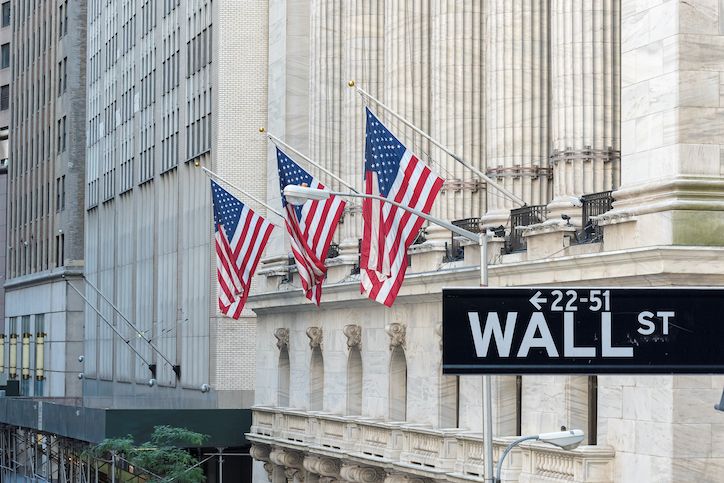
Markets Between Euphoria and Fear. Wall Street Collides with Reality and Delivers the Bill
The market is moving from the age of big promises to one of scrutiny. Artificial intelligence will continue to reshape the economy, but not every company investing in it today will manage to turn this revolution into proportionate profits
There is always a moment when investors stop asking how far certain markets can rise and start asking how sustainable that growth really is. That moment is probably happening right now: after months of enthusiasm, lofty expectations and capital poured into the technology sector, something is changing.
The week just ended sent a fairly clear signal: on Friday, October 30, the Nasdaq fell 2.86%, posting its worst session since June, while the S&P 500 gave up 1.82%. October closed with a 5.3% loss for the Nasdaq, its worst since March 2025. The trigger was mainly the quarterly results of some of the leading players in the technology revolution. Amazon disappointed analysts and reported negative free cash flow of $42.4 billion over the past twelve months, while at the same time confirming planned investments of around $220 billion in 2026. Intel, meanwhile, surprised the market to the downside with revenue guidance below expectations, losing nearly 29% in a single session. Alphabet also posted disappointing results and negative cash flow, recording the sharpest daily decline in its history.
These are not necessarily companies in structural difficulty, but rather companies from which the market expects an enormous amount. And when expectations are this high, even economically positive results — but with a few shadows — can be enough to spark anxiety and fear. The real issue, however, runs deeper and concerns artificial intelligence. The big technology groups are investing staggering sums in building data centers, infrastructure, processors and computing systems. According to estimates circulating in the market, the main American hyperscalers could end up investing a combined total of around $700 billion in 2026, with further increases expected next year.
The question investors are beginning to ask is simple: when will the economic returns on these investments arrive? Because building extremely costly infrastructure does not automatically mean generating proportionate profits. And this is where another factor comes in that could alter the sector’s balance: Chinese competition. Models such as those developed by DeepSeek and Moonshot are showing that increasingly competitive performance can be achieved at significantly lower costs than American solutions. The accusations of unlawful distillation made by some U.S. companies against Chinese labs add more questions, but the economic fact remains: the technological edge may last for less time than investors imagine.
So if artificial intelligence performance becomes progressively accessible at lower costs, the profit margins of the sector’s leading players could also suffer. It is no coincidence that the SEC has begun reviewing communications from companies active in artificial intelligence, with particular attention to transparency around risks and economic prospects. Added to this is the growing concern over the debt of the companies building the infrastructure needed for the AI revolution. In short, the market is not necessarily questioning the future of artificial intelligence, but it is beginning to ask for the bill for getting there.
In the meantime, we are also seeing a rotation of capital; while technology and semiconductors are being sold off, traditionally more defensive sectors such as healthcare and consumer staples are showing greater resilience. Some sector ETFs have even reached new highs, while names like Walmart, Coca-Cola and several pharmaceutical companies have benefited from the shift in investments. It is a typical pattern in phases of rising uncertainty: market participants reduce exposure to assets seen as more vulnerable and look for assets with more predictable cash flows.
However, the macroeconomic picture presents other complications: the Federal Reserve left rates unchanged in October, while keeping open the possibility of further hikes. Market expectations remain tilted toward monetary policy that is still restrictive, while some analyses, including Morningstar’s, point to a different scenario: a possible final hike in December, followed by a phase of rate cuts during 2027 and 2028. The reasoning is interesting: if investments in artificial intelligence were to slow down, or if automation were to produce a significant drop in employment, economic pressures could ease, pushing the Fed toward a more accommodative monetary policy. It is not a certain forecast, but it shows how closely the fate of rates is now intertwined with that of the technological revolution.
On the commodities front, by contrast, mixed signals are emerging. Oil continues to be supported by geopolitical tensions and difficulties in energy supply, with Brent rising above $117 a barrel in Friday’s trading. In Europe, natural gas also saw a sharp jump, fueling fresh concerns about inflation heading into winter. Gold, on the other hand, went through a sharp correction, falling below $4,000 an ounce and moving well away from the highs reached in January. A decline that is a reminder that even assets traditionally seen as safe havens are not immune to profit-taking, especially after exceptional rallies.
Bitcoin and the cryptocurrency space are also in a delicate phase, caught between volatility, regulatory uncertainty and new concerns over exchange security, following reports of the huge cyberattack that allegedly hit Binance.
What should we expect now? In the short term, there are at least three scenarios. The first is a continuation of the correction: if the next earnings reports confirm growth in profits below expectations and investments in artificial intelligence keep rising without any clear prospect of profitability, we could see further selling, especially in technology stocks with high valuations.
The second scenario is stabilization: companies show that investments are beginning to produce results, earnings growth remains solid and the current declines become an opportunity to bring valuations back into line. In that case, the market could gradually recover, also through greater participation from sectors that have so far remained in the background.
The third scenario, perhaps less considered by investors, is a more lasting rotation: not necessarily a collapse in Wall Street, but a change in market leadership, with a gradual reduction in the concentration on big technology names and greater attention to companies, sectors and geographic areas with more reasonable valuations. After all, Morningstar’s indicators continue to show a U.S. market that is relatively expensive by historical standards. The price/earnings ratio stands at around 23.83, still in the upper part of the range of the last twenty years. This does not mean Wall Street must necessarily fall, but it suggests that the margin of safety is smaller and that any disappointments could have a bigger impact.
For investors, then, this is a time that calls above all for discipline. Chasing gains when enthusiasm is at its peak and panicking when corrections arrive are two behaviors that rarely produce good long-term results. Those investing through a savings plan should remember that periods of volatility are part of the journey and that a correction can also make it possible to buy units at more favorable prices. Naturally, this does not mean every dip is automatically an opportunity: the quality of the instruments, diversification, the time horizon and the ability to withstand potential losses all matter.
In a context where American valuations remain elevated, rates are still relatively high and geopolitical tensions continue to affect energy and inflation, having a portfolio diversified across regions and different asset classes can become particularly important. The real lesson of these weeks is probably that the market is moving from the age of big promises to one of scrutiny. Artificial intelligence will likely continue to transform the economy, but not every company investing billions today will necessarily manage to turn this revolution into proportionate profits. And Wall Street, sooner or later, always sends the bill.
For investors, this is not the time to try to guess every move in the market, but to understand which risks are rising, which opportunities are emerging and, above all, whether their portfolio is built to handle more than one scenario. Because in financial markets, the winner is not necessarily the one who can predict next week, but the one who can stay clear-headed when everyone else starts losing their way.
Newsletter
The Patrimoni & Finanza newsletter
A considered selection of analysis on economy, Real Estate and wealth
The subscription service is not connected yet: no address is stored