
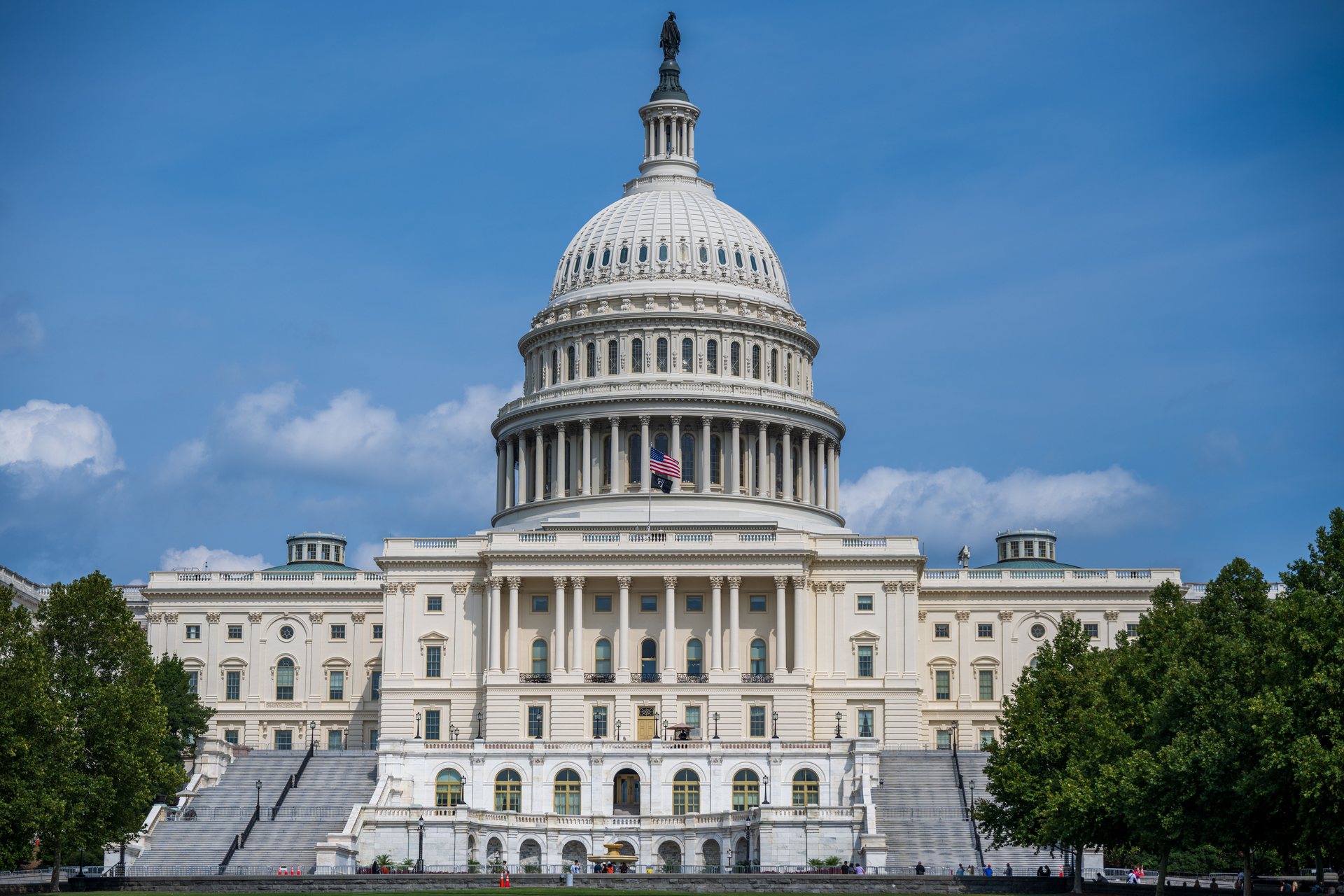
US midterms and markets after the Democratic victory
Congress changes majority, but Trump keeps the veto. MFS’s analysis explains why legislative gridlock may reassure markets and where risks remain for investors and companies
The Democrats’ victory in the House and Senate in the midterm elections on 3 November opens a period of divided government in the United States. The White House remains Republican and the new majority does not have the votes to overturn a presidential veto. According to the MFS Market Insights Team, which examined the vote in its November report, the most likely outcome is a Congress able to slow many of Donald Trump’s initiatives, but with limited room to impose its own agenda. In the final two years of the term, the White House could therefore make greater use of executive powers.
Legislative gridlock and markets
For MFS, this outlook may have a favourable side for investors. If Congress and the White House have to reach agreement, it becomes harder to approve large spending programmes or rapidly change the rules governing entire sectors. For a company that has to decide whether to commit capital to a new plant, a lower probability of sudden changes can help with planning. However, there remains a difference between the stability of existing rules and the ability to take decisions when a deadline approaches.
MFS cites a historical series from Deutsche Bank: in the twenty prior midterms considered, starting from 1946, the US equity market was always higher twelve months after the vote, with an average gain of 14.4%. The statistic relates to midterm elections in general and does not isolate the effect of a Congress divided from the White House. It is a useful precedent for putting the volatility of the first trading sessions into perspective. To interpret the coming year, the authors recommend focusing above all on earnings, the state of the economy and monetary policy.
Where the outlook may change
In healthcare, MFS highlights the case of hospitals and other care providers: if the likelihood of Medicaid cuts falls, one of the risks linked to public funding eases. In energy, the authors expect a less unfavourable legislative environment for clean sources and closer parliamentary scrutiny of the energy sector. In defence, a possible reshuffling of spending priorities could instead complicate the outlook for some suppliers. These are possible effects on sector policy, not forecasts for the returns of the relevant shares.
On the return of manufacturing production to the United States, the report sees more continuity. Bipartisan support reduces the likelihood of new obstacles in Congress for sectors such as semiconductors and electrical equipment. For artificial intelligence the picture is less straightforward: in Washington the debate may focus on data privacy, while at state level the building of data centres may face more resistance because of the impact on local communities. For companies in the sector, following the decisions of individual states therefore matters even when no new federal law passes Congress.
The deadlines that require agreement
Gridlock has a limit: some decisions cannot be postponed indefinitely. Among the points of friction, MFS identifies spending authorisations and the debt ceiling, as well as imbalances in federal social security and funding for the war with Iran. AI regulation can add another area of confrontation between Congress and the administration. To assess political risk, it is therefore worth distinguishing between reforms that can remain stalled for months and decisions that force the parties to negotiate by a deadline. It is on the latter that the absence of agreement can weigh most heavily.
What to watch in portfolios
MFS’s conclusion concerns portfolio construction. The vote offers an opportunity to check how exposed you are to a single sector or to a particular political outcome, and whether investments are still consistent with your horizon. For example, holding more funds can give the impression of diversification even when they are all concentrated in the same big technology companies. It is a more useful check than attributing to a parliamentary majority the power to determine the direction of Wall Street over the next two years.
Source: MFS Market Insights Team, 2026 US Midterm Elections: Gridlock Expected After Blue Wave, November 2026. Historical series: Deutsche Bank, The Ballot and the Bull, 3 November 2026, cited by MFS.
Tags
Related articles


Newsletter
The Patrimoni & Finanza newsletter
A considered selection of analysis on economy, Real Estate and wealth
The subscription service is not connected yet: no address is stored