
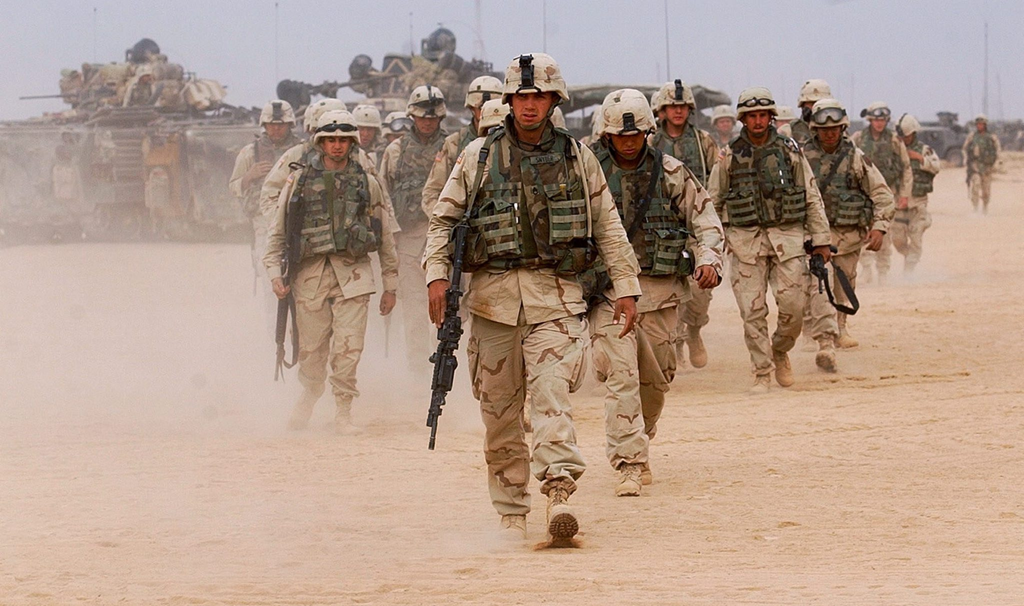
United States, 100 years of wars and lies to cover economic interests. A critical perspective
For the USA at war around the world, democratic ideals and values have served only as a façade to justify interventions aimed at securing their economic and political supremacy.
By Valerio Giunta, CEO of Startup Italia and Founder of Banking People
According to the most widely held economic and social theories, there are numerous determinants of wars between states and local conflicts, but academics struggle to find consistent results that apply to every war. In civil wars, for example, the only variable on which most economists agree is the economic one, both in terms of per capita GDP and economic growth; however, this does not explain the policy of military intervention that the United States has adopted since the First World War.
According to Noam Chomsky, many American wars have been presented as moral or ideological missions, but the reality often conceals a vast network of economic interests. Indeed, the economic reasons behind American interventions in various world conflicts have been many and often intertwined with strategic, industrial and financial interests. For example, in the First World War (1917-1918) the USA intervened to protect its investments and credits, having lent huge sums to the Entente countries (Great Britain and France). If Germany had won, the risk of not recovering those loans would have been high. In addition, American industry (steel, automotive, textile, etc.) made enormous profits from supplying weapons, ammunition and materials to the Allied countries. Finally, an Entente victory would have strengthened the American allies, preserving markets and trade routes vital to the US economy.
In the Second World War, by contrast, the USA gave a major boost to GDP after the Great Depression, thanks to rearmament and wartime production, creating millions of jobs. With the two world wars, in substance, the United States strengthened its role as a global economic power, replacing Great Britain as the main economic and financial player, and with the Marshall Plan and the Bretton Woods agreements it enshrined the dollar as the reference currency, consolidating its economic dominance. In the subsequent wars (the Cold War and beyond, as we shall see), American military interventions continued with economic motivations often linked to the control of natural resources (oil in the Middle East, strategic raw materials), support for the military industry (which is a key component of the American economy) and the protection of investments and multinationals threatened by communism (Vietnam, Korea, Latin America).
Here is a summary of the economic motivations that led the United States to intervene in each conflict.
1. First World War (1917-1918)
Official narrative: Make the world safe for democracy.
Economic motivations: the United States had invested enormous capital in the Allied countries through loans and war supplies. An Allied defeat would have resulted in catastrophic financial losses for American banks and industries. In addition, the war opened new markets for American exports and consolidated the position of the dollar internationally, marking the beginning of the rise of the USA as a global economic power.
2. Second World War (1941-1945)
Official narrative: Stop fascism and protect freedom.
Economic motivations: the war boosted the US manufacturing industry, ending the Great Depression thanks to wartime production. After the war, the United States implemented the Marshall Plan, which not only helped rebuild Europe but also secured markets for American products and cemented the dollar as the dominant currency in international trade. In addition, control over global energy resources became crucial in the postwar period.
3. Korean War (1950-1953, over 1 million deaths)
Official narrative: Defend South Korea from communist tyranny.
Economic motivations: after the much-mythologized 1964 Gulf of Tonkin incident (the so-called casus belli), the conflict enabled the United States to consolidate a strategic presence in Asia, protecting important maritime trade routes and gaining access to emerging markets. The American intervention also secured indirect control over mineral resources such as iron, coal and rare earths, which are vital for the technological and military industries.
4. Vietnam War (1955-1975, between 3 and 4 million deaths)
Official narrative: Stop communism and defend the freedom of peoples.
Economic motivations: the southeast Asian region was rich in natural resources, including rubber, oil and rice, all crucial to the American economy. The United States feared that a communist expansion in the region could restrict access to these goods and destabilize key markets. In addition, the war fuelled the military-industrial complex, strengthening the war industries that benefited enormously from the continuous production of weapons.
5. Yom Kippur War (1973)
Official narrative: Defend Israel, a democratic ally, from Arab aggression.
Economic motivations: ensuring control over the stability of the oil market and responding to the energy crisis triggered by the Arab oil embargo; putting Europe, heavily dependent on energy, under pressure; strengthening the petrodollar system, ensuring that oil was sold in dollars and consolidating the position of the dollar in the global economy.
6. Gulf War (1990-1991)
Official narrative: Liberate Kuwait and stop Iraqi aggression.
Economic motivations: control of oil was central. The Iraqi invasion of Kuwait threatened the stability of the Persian Gulf, which supplied much of the world's oil. The United States, with the help of its allies, intervened to preserve the security of energy resources and maintain the "petrodollar" system, in which oil is traded in US dollars, thus strengthening the US economy.
7. War in Afghanistan (2001-2021, about 240,000 deaths)
Official narrative: Respond to the 9/11 attacks and fight terrorism.
Economic motivations: beyond the narrative of the fight against terrorism, Afghanistan is a strategic region close to rich reserves of natural gas, oil and rare minerals such as lithium and rare earths, which are crucial for modern technologies. The conflict also kept the military-industrial complex in business for two decades, bringing enormous profits to defence companies.
8. War in Iraq (2003-2011, 500,000 deaths)
Official narrative: Eliminate weapons of mass destruction and bring democracy.
Economic motivations: weapons of mass destruction were never found, and a few years later there were partial admissions about the obvious nature of a fake casus belli. In truth, Iraq has some of the largest oil reserves in the world. The American invasion allowed US oil companies to gain direct access to Iraqi reserves and influence oil production and trade in the region. In addition, the reconstruction of the country generated billions of dollars in contracts for American companies in the construction, security and infrastructure sectors.
9. War in Libya (2011)
Official narrative: Protect civilians from the repression of Gaddafi's regime; prevent a possible genocide in Benghazi; support democracy and the Arab Spring movements.
Economic motivations: securing access to Libyan oil and gas for France and Germany, weakening Gaddafi and preventing an economically independent Africa. In addition, favouring Western companies in reconstruction and weakening Italy, Libya's first Western interlocutor.
10. Recent interventions (Syria and Ukraine)
Official narrative: Protect democracy and human rights.
Economic motivations: in the conflict in Syria, control over energy routes (pipelines and oil pipelines) and access to the regional energy market have been determining factors; in the war in Ukraine, the United States supports Kyiv to counter Russian influence over energy routes to Europe, also consolidating the sale of American liquefied natural gas to European countries.
The “counter-proof” of the prevalence of economic interests over American intervention in armed conflicts can easily be found in the case of the Rwanda-Congo War (Second Congo War, 1998-2003). On that occasion, in fact, the “moral” reasons for intervention were all there: protection of civilians from mass violence, genocide and ethnic cleansing; promotion of stability and democracy in the region; containment of humanitarian crises, including millions of displaced people. The estimated death toll was staggering: about 5.4 million people, most of them killed by starvation, disease and indirect consequences of the conflict. Naturally, civilians accounted for the vast majority of the victims (in addition to the thousands of soldiers and militiamen killed in the fighting).
So why did the USA not intervene? It is easily explained. First of all, there were no direct economic interests: despite the enormous wealth of mineral resources (gold, diamonds, coltan), the USA saw no immediate direct gain from intervention, leaving control of the resources to multinationals. In addition, the conflict involved numerous regional actors (Rwanda, Uganda, Angola, Zimbabwe and local militias), making an effective intervention difficult. Finally, the United States was already engaged in other military and geopolitical operations (such as the war in Kosovo and the fight against emerging terrorism).
In the end, the Congo War was described as "the largest war forgotten by the Western world", and it shows how the USA avoided military involvement despite serious human-rights violations, because direct strategic and economic interests did not justify intervention. It is therefore easy to conclude that behind every American war lie complex interwoven economic interests, and that their common denominator is control over natural resources, the maintenance of the dollar as a global currency and the expansion of the market for American companies. Democratic ideals and values, clearly, seem to be nothing more than a façade to legitimize interventions aimed at securing economic and political supremacy.
Tags
Related articles


Newsletter
The Patrimoni & Finanza newsletter
A considered selection of analysis on economy, Real Estate and wealth
The subscription service is not connected yet: no address is stored