

Litigation Funding as a strategic tool for Italian SMEs and private individuals
Litigation Funding helps SMEs face domestic and international disputes and mitigate the risk of an adverse outcome. For private individuals, it offers support in the most financially demanding disputes.
By Davide de Vido, lawyer at the Treviso Bar and CEO of FIDEaL of the economy
Small and Medium-sized Enterprises (SMEs) are the backbone of Italy, accounting for the vast majority of the national business fabric. There are around 4.4 million of them, equal to 94% of the total number of companies operating in the country; they employ more than 15 million people (around 81% of the private-sector workforce), generate about 65% of the country’s value added at factor cost (VAF), and account for more than 80% of Italian exports. In other words, Italian SMEs are a precious resource for the country, and their success is essential to the growth and competitiveness of the national economy, as well as to employment levels.
Among the various risks affecting companies and potentially hindering their activity and development - especially for companies with a strong export orientation - there is certainly that of legal disputes. Companies may in fact become involved in complex and costly court or arbitration disputes of a commercial nature (breach of contract or disputes with suppliers and clients), corporate nature (for example, those relating to the liability of directors or auditors, disputes between shareholders or between shareholders and the company, or even between companies following extraordinary corporate transactions M&A Transaction), those concerning intellectual property, those concerning breaches of competition and market rules by third parties (the so-called Antitrust disputes) and, even, those concerning the rules governing investments made to start activities abroad, etc.
Private individuals also face certain categories of disputes of an individual nature but with a major economic impact on family life. Think of claims for compensation for personal injury (e.g. insurance claims for serious road accidents caused by third parties) or cases of medical malpractice, which can result in extremely serious damage up to the death of a relative (the so-called thanatological damage), especially where that relative was the sole income earner in the family. For all of them, the prospect arises of having to pursue complex, costly and lengthy civil proceedings, which often discourage those entitled to bring claims; this is especially true for those in lower income brackets - but not low enough to qualify for state-funded legal aid - for whom access to civil justice entails prohibitive entry costs (unified court fee, legal fees, expert opinions, party-appointed experts) that are impossible to bear without resorting to debt.
As regards companies, legal disputes generate direct costs relating to legal and/or technical assistance and administrative expenses for access to justice, as well as indirect costs such as balance-sheet provisions (risk and expense funds) against the risk of an adverse outcome, which is inherent by definition in any dispute. Not all SMEs have the financial strength to bear such costs, either because they often do not have the financial resources to meet them or because, at a given moment, they need to allocate those resources to growth rather than to handling a dispute. These situations can translate either into an inadequate defence or, even worse, into a case of denial of justice because companies, ob torto collo, choose not to pursue and defend their rights.
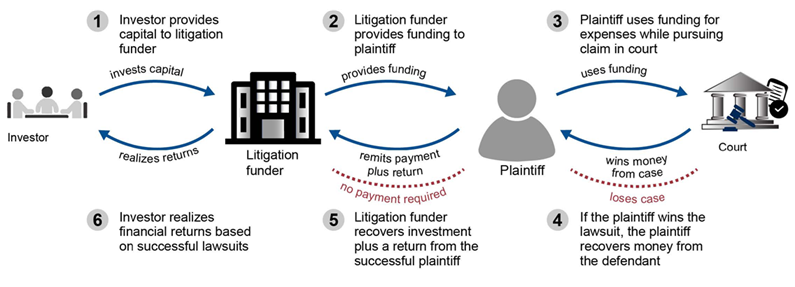
In this context, SMEs today can rely on a new and innovative strategic tool capable of providing the financial support and expertise needed to pursue their rights in court: Litigation Funding, known in Italy as financing of litigation. This is a legal and economic arrangement in which one or more funders invest in a third party’s dispute (pre-litigation, court or arbitration), in which they have no interest, assuming the costs of the dispute and the resulting risk of failure, namely the risk of losing the investment and having to pay the opposing party’s legal costs. In return, but only and exclusively if the dispute is successful, the funders will receive a share of the proceeds arising from the outcome of the case, whereas in the event of failure the funded party will not have to repay anything to the funder, nor pay any fee for the service.
How does Litigation Funding work? Regardless of the legal form of the funder (authorised fund, foundation, trust, purpose association, etc.), the litigation funding process generally unfolds as follows:
a) the interested party submits their request to the funder;
b) the request must include a detailed description of the dispute, its chances of success and the expected costs;
c) the funder evaluates the request and, if the assessment is positive, proposes a contract setting out the terms of the investment, including the amount of the funding, the share of the proceeds due to the funder, etc.;
d) the funder covers the legal costs and other expenses connected with the dispute;
e) depending on the court outcome, if the case succeeds the funder receives a share of the proceeds obtained in court, and if it fails the investment is lost, leaving the funded party free of any financial obligation.
The advantages of litigation funding are numerous for both SMEs and private individuals. SMEs, in fact:
- will be able to pursue their legal rights even against larger, more financially solid opponents, without having to worry about the substantial legal fees;
- will be able to transfer the risk of financial losses associated with the dispute to the funder, thus also protecting their financial stability and focusing on their core activities, while delegating the financial management of the dispute to the funder;
- in transnational disputes, where language, cultural and legal barriers can hinder access to justice, funders with specific expertise can provide SMEs with the knowledge and assistance needed to navigate the complex challenges of such disputes.
Private individuals, on the other hand, can find financial cover for technical and legal expenses and for those relating to access to Justice - in high-value cases, the unified court fee alone can exceed 2,000 euros - and thus face, on an equal footing, opponents of the calibre of insurance companies or hospital trusts.
Tags
Related articles



Newsletter
The Patrimoni & Finanza newsletter
A considered selection of analysis on economy, Real Estate and wealth
The subscription service is not connected yet: no address is stored