
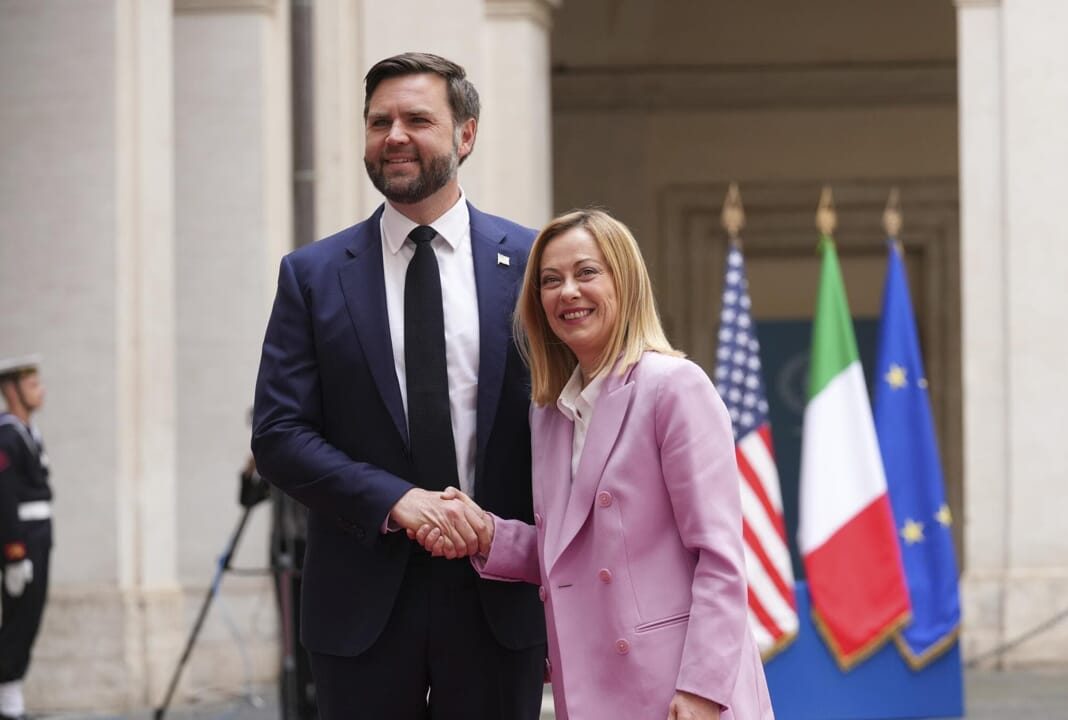
Divide et Impera Part II: the strategic significance of JD Vance’s visit to Italy and India
Vance’s visit last April to Italy and India was not a simple diplomatic trip, but a carefully designed move to realign the global balance of power.
by Valerio Giunta, CEO of Startup Italia and Founder of Banking People
When it comes to global geopolitical dynamics, it is worth taking a deep look at Vance’s “strange trip” last April to Italy and India. In fact, this visit embodies the Anglo-Saxon imperial doctrine of “divide et impera”, and is therefore aimed at splitting rival blocs and strengthening American influence in Europe and Asia. Much like the good-cop, bad-cop routine, in this case played respectively by Vance and Trump. Let us see why this low-profile trip is of such great interest.
Officially, the public agenda spoke of “strengthening ties between the world’s largest democracies”, but some observers quickly read a deeper signal into the mission: namely, the Trump administration’s attempt to restore effective American leadership through the selective splitting of rival blocs. Not by chance, Italy, the EU’s weak link, and India, an ambivalent power still balancing between BRICS and the West, were the only two stops chosen.
Italy between Atlanticism and strategic ambiguity
Historically, Italy has been a battleground for outside powers. It is now an established fact that, during the Cold War, the CIA financed Democrazia Cristiana against the PCI to keep the latter out of government starting with the 1948 elections; while in later years, clandestine operations such as Gladio sought to prevent the rise of the left. Key episodes such as the assassination of Aldo Moro (1978) can be placed within the same objective of thwarting the historic compromise, while the Sigonella standoff (1985) with the United States showed how crucial control of Italy was deemed to be. The fall of Craxi and the implosion of the First Republic, Mani Pulite and so on, are seen by some as the outcome of a post–Cold War reconfiguration, and once again demonstrate that in Italy no government can rule without the U.S. blessing.
Under Giorgia Meloni, a sovereignist and pragmatic leader, Italy has taken on a dual role: an Atlantic partner, but also a seemingly aligned interlocutor with respect to the official positions of the EU. Vance’s visit to Rome reinforced the perception of this ambiguity. Although Meloni represented Europe in talks with Trump, she was then excluded from the delegation of European “willing” countries convened by Zelensky: a sign that Brussels and Paris do not fully trust the Italian position, seen as too closely tied to Washington. Italy is now being courted by the U.S. to break European alignments on trade and strategic matters, and Rome is trying to leverage this ambivalent role.
India between multipolar balances and economic sovereignty
The case of India is even more emblematic. On the one hand, Delhi takes part in the Quad (with the U.S., Japan and Australia), signs defence agreements (such as the BECA with Washington) and strengthens cooperation on semiconductors and cybersecurity; on the other, it remains tied to Moscow, from which it imports weapons (such as the S-400 systems) and low-cost crude oil. In 2024, Russia indeed became India’s top oil supplier (around 2 million barrels a day), and India avoided sanctions while maintaining a narrative of “active neutrality”. During Vance’s visit, crucial commitments were reached: a roadmap toward a $500 billion free-trade agreement by 2030, cooperation on defence and technology, and a temporary suspension of the massive U.S. tariffs. But it is the bilateral approach – outside multilateral settings – that stands out: Washington deals directly with Delhi, bypassing the WTO or other official forums, showing how central India is considered in containing the alternative China-Russia axis.
The Kashmir crisis: the first strategic consequence
Just days after Vance’s visit, a new Kashmir crisis erupted between India and Pakistan. Although linked to long-standing tensions, the timing leaves room for strategic interpretations. China, Pakistan’s partner, defended Islamabad with military and diplomatic means: the J-10 jets supplied by Beijing were used in combat operations to defend the China-Pakistan Economic Corridor (CPEC) crossing the disputed territories, irritating Delhi (which, with its French Raphael fighters,
fourth-generation aircraft bought at a very high price, has perhaps realized it is not quite ready for an armed confrontation...). The U.S., meanwhile, kept a low profile, while publicly reiterating the importance of de-escalation. Their attention is clearly focused on consolidating the understanding with Modi and pushing India toward the anti-Chinese camp. In this context, the regional conflict can become a test of Indian loyalty and of the new global order. Not by chance, Modi had other commitments and did not take part in the victory parade held in Moscow.
The echo of an imperial strategy
Vance’s trip therefore did not produce only economic agreements and joint statements: it reactivated dynamics of selective pressure and balancing that echo historical models of geopolitical management. Italy, as a fragile bridge between the EU and the U.S., and India, as a mediator between rival blocs, represent for Washington essential tools for containing the strengthening of the Sino-Russian axis and of a united Europe. The crises that emerged immediately afterwards – such as the Indo-Pakistani conflict – are the litmus test of the tensions this policy inevitably generates. But for the United States they are essential steps in continuing to shape the global disorder according to its own interests.
Related articles


Newsletter
The Patrimoni & Finanza newsletter
A considered selection of analysis on economy, Real Estate and wealth
The subscription service is not connected yet: no address is stored