
Between the Fed and Trump, a fake clash: U.S. financial markets now "nationalized" by the Treasury Department
The clash between the Fed and the U.S. government is only apparent, since the FED provides ample liquidity to the banking system so that it can buy Treasury securities: a new "indirect" QE is already under way.
By Maurizio Novelli, manager of the Lemanik Global Strategy fund
All consensus macroeconomic research continues to focus on tariffs and on the impact they may have on the economy, with a boring narrative that analyzes in detail, sector by sector and country by country, how much the economy will contract and how much inflation will rise. But every week these analyses become "worthless paper," since things keep changing according to the moods of the U.S. administration.

All of this is aimed at distracting attention from the fact that American financial markets are now entirely nationalized. The Treasury Department now effectively runs the equity indices and also the level of interest rates on Treasuries. The violent reversals that the American equity markets have undergone in recent months have been the result of intervention operations by the Treasury Department, with the participation of some Hedge Funds particularly close to the U.S. government. Intermediaries that have access to credit lines capable of lifting the market in the most critical moments, but also privileged information on the statements and moves of the White House, which is probably at the epicenter of a colossal round of insider trading. In fact, the drift has been well known for some time, given that members of the U.S. Congress and the Fed have repeatedly been censured by the press for the intense trading activity carried out by some institutional figures.
Meanwhile, interventions by the Exchange Stabilisation Fund, the intervention fund wanted by U.S. Treasury Secretary Bessent to put a cap on ten-year yields, are managing fairly well the heavy selling pressure on U.S. Treasuries from international investors, even though the Fed has been forced to step in with a QE of $43 billion in recent days to buy government securities on the market. Banking institutions will be able to purchase U.S. government bonds without limits, thanks to a measure in the process of approval that removes the risk on positions in American government securities from banks' capital ratios. All this confirms what I had already forecast some months ago about the risk that the U.S. financial market would be nationalized in an attempt to avoid a crisis triggered by unsustainable fiscal policies.
These days we are learning that the budget bill under discussion in the Senate (and already approved by the House) sets a Deficit/GDP path of -8% for the next ten years, with no recession foreseen, steady growth of 2.5%, inflation at 2% and interest rates on the debt fixed at 3.5%. This "sophisticated" macroeconomic forecast resembles the economic plans of the former Soviet Union, although in truth the Politburo went no further than five-year plans. The United States can easily manipulate the stock market, given that it now has a meager presence of institutional investors, and can introduce yield curve control, thanks also to the help of banks and the Fed, but it cannot control the level of the dollar, which risks becoming the potential trigger of a U.S. crisis.
The Japanese government bond crisis. The size of the foreign exchange market is beyond any possible control and requires coordinated action by Central Banks to have any effect. Recently the BOJ stepped in to weaken the Yen and slow a possible break in the colossal carry trade positions in place, since the uncontrolled rise in Japanese rates, triggered by the failure of numerous government bond auctions, had already spread to the USD/JPY cross. We do not know how long this situation can hold, but for now a bandage has been placed on the dam of carry trades that support the American financial assets held by Japan.
The crisis in Japanese government bonds is another problem added to a global financial system that is leaking from every side and that now requires a daily bail out. Japan's problem now risks becoming another negative systemic factor for the United States. The strategy of Japanese policy makers was clear: launch a reflationary policy to escape the trap of deflation, gradually erode the enormous public debt through inflation, and support wage growth to revive domestic consumption. That strategy was based on a devaluation of the Yen to trigger imported inflation, keeping rates at low levels (negative real rates) and stimulating domestic consumption through higher wages.
In fact, inflation has taken off (it is now at 3.6%), the Yen has depreciated and has favored carry trades into the dollar, rates have always remained rather low (0.5%), but the major Japanese institutions have begun to skip auctions of government bonds. At that point the long end of the curve began to spike, seriously undermining the strategy of keeping the cost of public debt (240% of GDP) at acceptable levels and triggering an unwanted strengthening of the Yen, supported by expectations of rate hikes in Japan. But over the last three months the situation has begun to deteriorate and the reflationary policy has proven to be a boomerang. The economy has begun to slow sharply, rates could therefore no longer be raised, but inflation continued to rise nonetheless, putting the BOJ's strategy of containing the cost of the colossal public debt under strain.
The crisis in government bond auctions therefore intensified, and the rise in rates began to erode the yield differential between U.S. Treasuries and JGBs, a differential that has always been the backbone of carry trades. The BOJ therefore had to step in to print money to buy government bonds and weaken the Yen, just as imported inflation seems unwilling to stop. At this point, if you do not want carry trades to blow up and a financial crisis to be triggered in the United States, you have to go back to doing QE, but if you go back to QE and weaken the Yen, you risk the trajectory of imported inflation creating further problems for government bonds, forcing the BOJ to intensify QE and weaken the Yen further, setting off an inflationary spiral that can only be stopped by a recession.
It is therefore clear that the propping up of U.S. debt depends on a Japanese recession that can extinguish inflation and keep a weak Yen in place to support carry trades. But the problem is that, in the meantime, the United States seems inclined to implement reflationary fiscal and trade policies, needs low interest rates to finance the debt (YCC), and pursues policies that cause capital flight from the U.S. and a weak Dollar. It is evident that the strategies of Japan and the United States are in a divergent phase, and this is yet another problem for international financial stability. The Dollar-Yen cross is therefore the dangerous intersection of the capital flows that support U.S. debt securities, but it has also become the main driver of Japanese inflation, creating domestic political problems and underground clashes between the BoJ and the government. While Japan needs the Yen to strengthen, the American government is calling for it to weaken while at the same time aiming to devalue the dollar. The context of global disorder, about which no one dares to speak, appears increasingly pronounced:
1) The United States cannot halt fiscal intervention because the financial system would not withstand a recession, but it does not want the expansion of debt to be financed by an increase in domestic savings. In fact, an increase in domestic savings would produce a drop in demand and a recession. So Japan, the banks and the Fed must finance the expansion of public debt, but rates must not rise so as not to cause a recession. The coincidence of uncontrolled debt and controlled rates is driving foreign capital out of the dollar.
2) Japan is forced to curb imported inflation but no longer wants to raise rates because the economy has stopped. The only way to stop imported inflation is to revalue the Yen, but that puts carry trades at risk. Auctions of government bonds are coming under strain and the Boj has to step in with QE, but QE weakens the Yen, which fuels imported inflation. There is a high risk that the carry trades financing an out-of-control U.S. debt will not hold.
3) Trade policies will produce inflation and a global economic slowdown. Uncertainty is curbing investments, and the international economy is already in stagnation now. The current economic stagnation is in fact already a recession, but the manipulation of macro data will continue to officially deny the recessionary scenario. The economic cycle has in effect been suppressed.
4) International investors are nonetheless moving out of the dollar, since in recent years American assets had attracted a record amount of foreign investments. The sale of American assets and the exit of capital from the dollar reduces the liquidity available to the U.S. financial system, which therefore now has to be provided by the Fed.
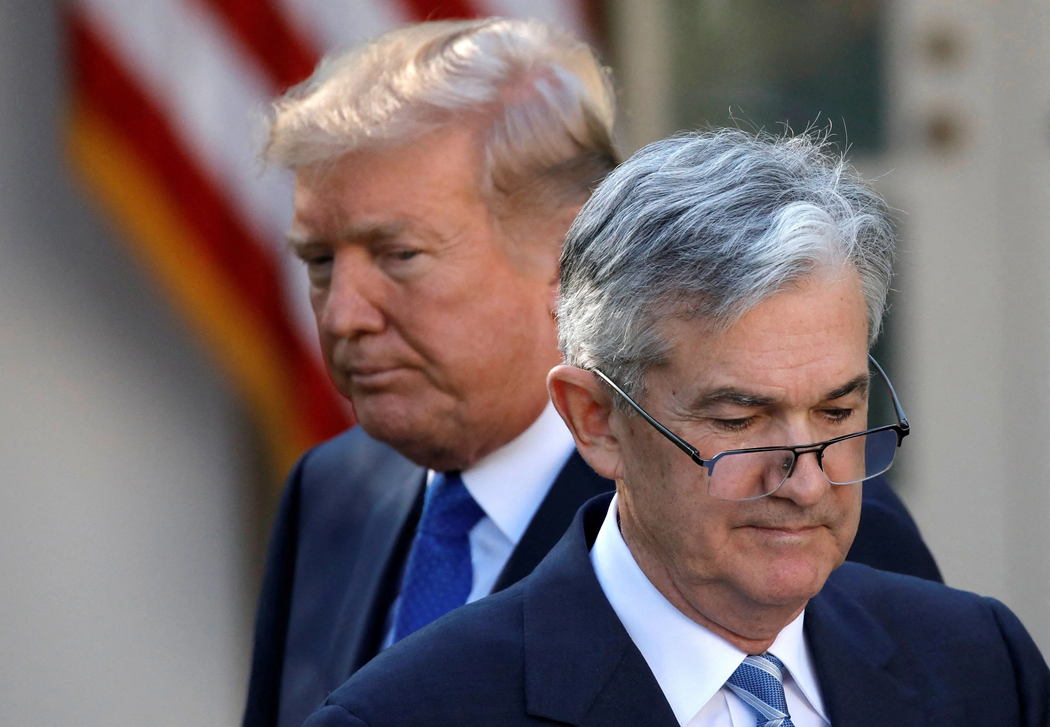
The Trump-Powell clash is only a staged performance. To avoid reopening a QE, which would be yet another factor weakening the dollar, the Fed is forced to inject reserves into the system through the banking channel, which becomes the main purchaser of Treasuries. It is in effect an indirect QE that will still lead to a weak dollar and inflation, but for now only insiders have understood it. The clash between the Fed and the U.S. government is only a charade to sustain a staged performance; Powell is aware of the state of the economy and knows that fiscal intervention is the only tool to avoid a fall into recession. The "struggle over rates" is only appearance; in reality, the Fed is providing colossal monetary support through the management of reserves in the system, which remain at $3.6 trillion versus the normal level of $1.8 trillion. Even so, the U.S. economy is in stagnation and is staying afloat only thanks to public intervention. American exceptionalism is rather costly and based on unsustainable debt: in 2024 it generated 2.8 tr of new public debt and 3.6 tr of new private debt (loans, private debt, corporate bonds, leverage loans, consumer credit, etc.), 6.4 trillion, to obtain $650 billion of GDP. But how long can it last?
It is clear that a system resting on this model requires a nationalization of rates and financial markets, a deregulation designed so that hidden losses are not booked in the balance sheets of those financing such a system (Banks and Shadow Banking), and the need to freeze the assets supporting it in some way. For this reason, there is talk of Century Bonds and potential capital controls. Meanwhile, in the general silence, the newly approved U.S. budget law in the House contains a provision allowing a tax on coupons and capital gains of up to 30% for all foreign investors holding American assets and belonging to countries that apply discriminatory taxation to major technology multinationals (Digital Tax). To make the context even more unsettling, one must know that among the U.S. President's special powers there is a law that allows, in the event of a "national emergency," the blocking of any capital outflow from U.S. soil... but if you don't know... everything seems fine.
Tags
Related articles


Newsletter
The Patrimoni & Finanza newsletter
A considered selection of analysis on economy, Real Estate and wealth
The subscription service is not connected yet: no address is stored