
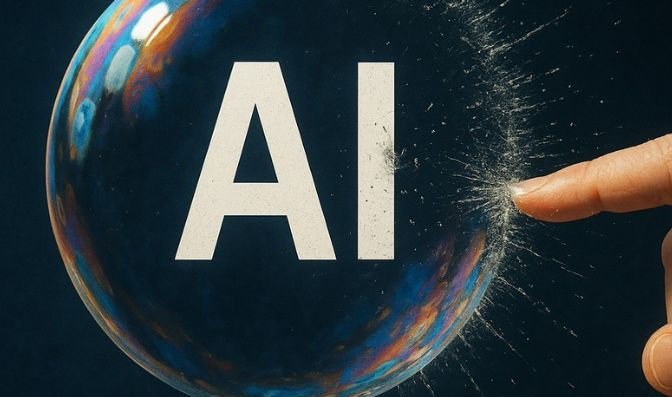
The real bubble is not Artificial Intelligence, but the concentration of sector stocks
How would “classic” portfolios react to a scaling back of expectations around AI? A revolutionary technology is not enough if the price paid for its future is too high.
by Vincenzo Lana
Over the past twenty-five years, financial markets have repeatedly shown how fragile they can be when enthusiasm, narratives and expectations overpower fundamentals. The dot-com bubble of 2000 and the 2008 financial crisis remain two landmark events, not only for the losses they caused, but for the way they changed the way entire generations invest. Today, with artificial intelligence at the center of the stage and markets driven by a handful of big technology companies, it is natural to wonder whether we are seeing a similar dynamic or whether history is, once again, merely rhyming.
The dot-com bubble was born out of a real revolution: internet was changing the world and no one could deny it. The problem was that the market began pricing in the future as if it were already here. It was enough to have “.com” in the name to attract capital, often without profits, without revenues and without a sustainable business model. The prevailing view was that profits would come later and that, in the meantime, growth justified any valuation. When it became clear that many of those companies would never turn growth into real profits, confidence dissolved quickly. The Nasdaq lost more than 70% of its value and, for many investors, the greatest damage was not so much the initial collapse as the very long period needed to get back to breakeven. The lesson was clear: a revolutionary technology is not enough if the price paid for its future is too high.
The 2008 crisis had a completely different nature. It did not arise from euphoria around a specific sector, but from a deep distortion of the financial system. Easy credit, excessive leverage and the belief that the housing market could not fall created an extremely fragile structure. When that mechanism broke down, it was not only stocks that were hit, but confidence in the system as a whole. Unlike 2000, when the crisis mainly hit technology, in 2008 almost all risky asset classes moved in the same direction. It was a systemic crisis, mitigated only by the massive intervention of central banks. From that point on, the concept of diversification began to be seen no longer as an optional choice, but as a necessity.
Turning to the present day, artificial intelligence is undoubtedly one of the most important innovations of recent decades. Unlike the dot-com era, however, the core of this transformation consists of companies that are already established, profitable and generating enormous cash flows. We are not dealing with startups lacking fundamentals, but with giants providing essential technology infrastructure. That makes an identical scenario to 2000, with a total collapse of the technology sector, unlikely. However, this does not eliminate the risks.
The first risk is concentration. Today, a significant share of the returns of American and global indices depends on a very small number of stocks linked to AI. When only a few names drive the market, it takes little more than a revision in expectations to trigger violent moves across the indices as a whole. The second risk concerns expectations themselves: the market is discounting rapid, sustained growth with almost no obstacles, while in reality the adoption of AI requires enormous investment, consumes capital and could compress margins in the short and medium term. The third risk is macroeconomic: unlike the past decade, the current environment is marked by higher rates, still-present inflation and greater geopolitical uncertainty. All factors that make the market less tolerant of very high valuations.
In this context, talking about a possible “AI bubble” mainly means questioning the level of valuations, not the validity of the technology. A realistic scenario is less a systemic collapse like 2008 or a wiping out of the sector like 2000, and more a phase of recalibration, in which prices realign with more sustainable growth. For some indices, especially those most exposed to American technology growth, this could translate into significant corrections. For others, more diversified, the impact would be more limited but still felt by the market.
And it is precisely at this point that the discussion shifts from markets to portfolios. Because beyond the analyses of bubbles, valuations and macro scenarios, what truly determines an investor's experience is not the behavior of a single index, but how capital is allocated. In recent years many portfolios have benefited from heavy exposure to American equities and technology, but this same factor can become a point of fragility if AI expectations were to be scaled back. If that happened, would the main “classic” portfolios be ready to face a change in market regime? Let’s look at them one by one.
60/40 portfolio - In the event of an AI-related correction, the bond component can reduce overall volatility, especially if an economic slowdown pushes central banks toward more accommodative policies. However, in a context of still-high rates, protection may be less effective than in the past, making 60/40 less “automatic” than it has been for decades.
Global 3 Asset - Adding a third “stabilizing” pillar, such as gold, makes this portfolio more flexible. In a scenario where expectations around AI are scaled back, this structure tends to limit losses and improve the speed of recovery compared with a simple equities-bonds mix.
Golden Butterfly – This portfolio combines assets with different behaviors. In a correction in technology stocks, the value components, gold and bonds help offset the weakness of growth equities. It is one of the portfolios that historically shows more contained drawdowns, albeit at the cost of more modest returns during periods of strong euphoria.
Global Market Portfolio – The Global Market Portfolio faithfully reflects the global market, with all that implies. Its heavy exposure to the United States and large technology companies makes it particularly sensitive to a correction in the AI sector. In the event of a recalibration of valuations, losses could be significant, while still remaining consistent with the overall long-term trend of the markets.
All Weather / All Season (Ray Dalio) - Designed to work across different economic regimes, this portfolio relies on strong macro diversification. In a scenario of uncertainty or slowdown, the bond component and defensive assets can offset losses in equities, making overall performance more stable and predictable.
Permanent Portfolio - This is the most extreme example of defensive diversification. With stocks, long-term bonds, gold and cash, it tends to lose little when markets are under stress. In a phase of correction linked to AI, it would probably be among the most resilient portfolios, albeit at the cost of more limited returns during periods of sustained growth.
Looking ahead, after a 2025 marked by macroeconomic uncertainty, geopolitical tensions and increasingly concentrated markets, 2026 could represent a turning point in the way investment is conceived. The question is not so much whether artificial intelligence will keep its promises, but whether it still makes sense to build portfolios heavily tilted toward a single growth scenario, as has happened in recent years. Perhaps the real issue is not predicting the bursting of a bubble, but asking whether the time has come to rethink diversification in a more conscious and structured way than in the past, accepting potentially less spectacular returns in the short term in exchange for a greater ability to navigate any market phase.
Tags
Related articles



Newsletter
The Patrimoni & Finanza newsletter
A considered selection of analysis on economy, Real Estate and wealth
The subscription service is not connected yet: no address is stored