

Choose your poison: geopolitics or artificial intelligence
For the Federal Reserve, carrying out the two interest-rate cuts currently priced in by markets may not be straightforward. Much will depend on how the labor market evolves.
By Daniel Morris*
Last week’s news highlighted several aspects of the potentially disruptive power of AI. Announcements of even higher capital investment spending by companies such as Alphabet, the parent of Google, point to lower profit margins. The wider availability of open-source artificial intelligence tools reduces competitors’ potential revenues and therefore calls into question the sustainability of such massive investment spending. It is difficult to quantify the overall impact of the “creative destruction” generated by AI on the labour market and consumer demand, especially when professional skills suddenly become far less valuable and jobs are lost.
The novelty of AI as a market factor, combined with the intense competition within the sector, makes this kind of surprise almost inevitable (remember DeepSeek?). Since last summer, volatility in the technology sector has been twice that of the rest of the market. It will take time for analysts to assess the net impact of all these factors and adjust earnings estimates. For that reason, a cautious stance is advisable in the short term. Nearly half of the companies in the Nasdaq 100 index have yet to report quarterly results. For the companies that have already announced their numbers, earnings growth looks solid, at 11% overall, but that is only in line with expectations, in a context where investors have become used to more sizeable positive surprises each quarter. For the S&P 500, by contrast, earnings growth is higher (14%) and positive surprises are also larger (8%), a factor that helps explain why non-tech stocks are outperforming.
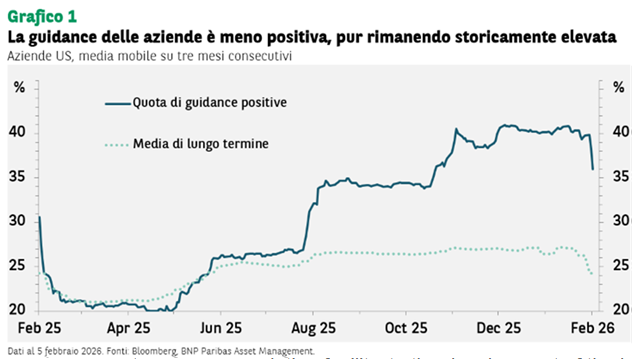
In addition to disappointing results, CEOs are also becoming less upbeat about the future. The share of positive guidance provided by companies has started to decline again, although it remains at historically high levels (see Chart 1).
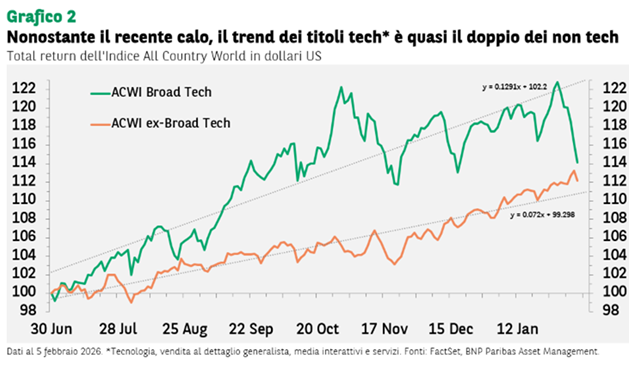
Although it makes tactical sense to be cautious, we remain optimistic from a strategic standpoint. The volatility of technology stocks has been accompanied by outperformance (though not recently). Since last summer, the slope of the trend line for the overall performance of technology stocks has been almost twice that of the market as a whole (see Chart 2).
Estimates for earnings growth in the technology sector may be revised lower, but they are still likely to remain clearly better than those for non-tech stocks. At present, profits for tech companies are expected to rise by 31% this year, compared with just 10% for non-tech stocks (for 2025, the estimates are 26% and 6% respectively). With such a wide gap, it is unlikely that non-tech stocks will outperform tech stocks over the long term unless the sector’s profit outlook worsens significantly or valuations come down.
Paradoxically, valuation risk may be greater for value stocks than for technology stocks. The z-score - a statistical measure of how far a financial instrument/index deviates from the average of zero - for the forward price/earnings (P/E) ratio of the Nasdaq 100 stands at 0.2, while that of technology stocks in emerging markets is in line with the long-term average (z-score of zero). For some value indices, however, the reading is significantly higher. Both the MSCI Japan and the Russell 1000 Value have a P/E z-score of 1.8. Europe is a partial exception, with a z-score of 0.5: above average, but not at extreme levels.
Recent events only reinforce the importance of good diversification of exposure to the technology sector, both across different industries and across regions, including developed and emerging markets. Diversification is always useful in a portfolio, but it becomes even more crucial given the speed at which the technology industry is evolving. Almost any player can be thrown off balance by innovation, but the new winner is likely to emerge within the same index. Losses on one stock should therefore be offset by gains on another, while overall earnings continue to grow.
January’s unexpectedly strong reading of the US manufacturing ISM, which rose to 52.6 (in expansion territory) after ten months below 50, highlights one of the risks to the positive scenario for US equities over the course of the year. GDP growth has averaged 4.1% over the last two quarters, and the Atlanta Fed’s GDPNow estimate is at 4.2%, well above the economy’s long-term growth potential, estimated at around 1.8%. Given that inflation could edge higher in the coming months as the distortions linked to shutdowns and weather conditions fade, it may not be easy for the Federal Reserve to deliver the two interest-rate cuts currently priced in by markets.
Much will depend on how the labor market evolves: on the one hand, labor supply is increasing because companies are laying off workers and replacing them with AI tools; on the other, it is falling because of deportations. A correction in equity markets to a smaller number of rate cuts (or no cuts at all) by the Fed would be traumatic, as a higher discount rate would reduce valuation multiples, particularly for technology stocks and small caps. Once that adjustment is complete, however, a scenario of solid economic growth and slightly higher inflation could support further market gains.
* Chief Market Strategist, Co-head of the Investment Insights Centre at BNP Paribas Asset Management
Performance data/data source: Bloomberg, FactSet, BNP Paribas Asset Management; as of 5 February 2026, unless otherwise specified. Past performance should not be taken as indicative of future returns.
Tags
Related articles



Newsletter
The Patrimoni & Finanza newsletter
A considered selection of analysis on economy, Real Estate and wealth
The subscription service is not connected yet: no address is stored