
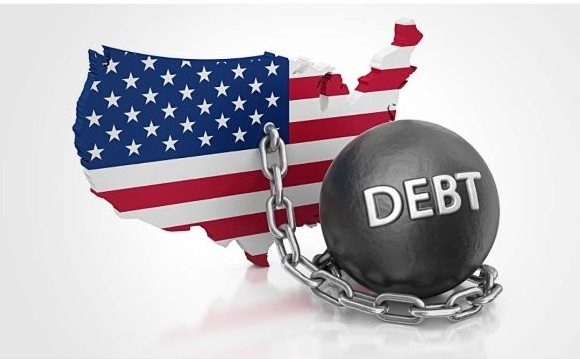
US economy, the growth model based on excessive debt is destined to fail
The United States are trying to repeat with the whole world the same operation they carried out with Japan in the 1990s, but China and Europe are not willing to accept it.
By Maurizio Novelli, manager of the Lemanik Global Strategy fund
We have probably reached the "peak" of the trade war between China and the United States, but thinking that the international environment can go back to the way it was before is pure illusion. The wide swings in equity market indices show that the consensus mindset is inclined to believe the system can easily shift from one scenario to another without damage. It is quite likely that efforts will be made to ease the tension that has been created, but the direction now taken is irreversible and the context has changed.
In fact, it must be borne in mind that the timeframes of trade negotiations run into months - if not years - and the solutions will therefore not be as easy as people tend to make them out to be. In the meantime, the balances on which global trade and globalisation have been built since 2000 are inexorably crumbling. Reading the "Foreign Trade Barriers" document published by the US administration, one can understand the American point of view but also the complexity of the negotiations and the prospective difficulties. It is quite clear that the hardest part to resolve concerns China and Europe, while an agreement with Mexico, Canada and Japan appears easier. It is therefore likely that tariffs may be partly reduced, but they will no longer be fully removed for many years.
A reverse New Deal. Financial markets tend to make it seem as though the underlying scenario has not changed, that these events are only temporary and that everything will return to normal. In reality, we are facing the most important global structural change in geopolitical, trade, economic and financial terms since the New Deal. The problem is that this is a reverse New Deal, in which the US economy no longer has the fiscal room to carry out the Keynesian policies it has relied on in recent years, yet it also has no intention of reducing the debt that is needed to sustain financial speculative bubbles. Markets continue to hope, in fact, that no restrictive fiscal policy will be possible. The attempt, then, is to contain a potential debt crisis by introducing a tax on domestic consumption, in the hope that it will provide the financial resources needed to preserve this unsustainable status quo.
Trade tariffs are essentially a form of taxation on global consumption, but especially on American consumption, given that US consumption accounts for about 25% of world GDP. Since the United States have based the growth of the last twenty years on leveraged domestic consumption (financed consumption), global demand has been driven by this exaggerated model of "debt-financed consumption", which over time has generated unsustainable global imbalances. To correct these imbalances, the United States would need to raise taxes on income, capital and Corporate America (which pays no taxes), thereby reducing domestic demand and thus imports and the external deficit, while also accepting a recession as a consequence. So the United States are left with taxing foreign consumption (stemming from imports), while making it appear that these taxes are paid by those exporting to the United States through "unfair" trade practices.
What will be produced, in any case, is a recession or a sharp global slowdown, but in this case the aim is to find an external cause, an enemy to blame, an external scapegoat (China or Europe) as regards the economic crisis and an internal one (the Fed) as regards the risk of a possible financial crisis. In 2019 the United States were already going through another 2008 but, thanks to Covid, fiscal and monetary interventions hid it, though only postponing it. The 2018 interbank market crisis had brought to light all the speculative credit in the Commercial Real Estate sector, the same sector that later caused the bank failures two years ago. Problems that were immediately contained with a few bailouts but never resolved and steadily worsening. At present around 450 American banks are in structural crisis and the Fed is providing constant credit lines to prop up the situation. Although it is quite clear that, in the meantime, everything has worsened in Commercial Real Estate credit (4.5 trillion dollars), the Consumer Credit sector (5.5 trillion dollars) has now been added to it, where default rates are already at pre-2008 levels despite full employment. I dread to imagine what could happen in the event of rising unemployment.
The Trump administration believes it can withstand a temporary recession brought on by the trade war and be able to revive the economy in the second half of the presidential term, but the global uncertainty created by the change in scenario under way will not be short-lived, and this will weigh on the international economy for a long time. Any production relocation of what has been set up in China is not an operation that can be completed quickly, assuming it is feasible at all, and in any case the costs would be colossal. A possible recession would create serious problems for the speculative credit embedded in the US Shadow Banking System (12 trillion dollars), worsening defaults, contracting credit to the economy and further aggravating the ongoing banking crisis.
I would remind readers that the big American banks refused to apply Basilea III so as not to bring to light the losses hidden in their balance sheets, balance sheets that are "beating estimates" ever more reduced, but which are not credible to the most careful analysts. I believe that sooner or later Powell's Fed will be called to testify before Congress for failing to monitor systemic financial risks and for having been formally independent of politics but not very independent of Wall Street. Another issue, in fact, is that for years the Federal Reserve has served only to provide bail out to Wall Street and has aligned itself with propping up a financial system that remains exposed to the highest risk, effectively abandoning its role of overseeing financial risks. The political clash over the Fed has only just begun. To think, therefore, that in just two years it would be possible to restructure the Global Value Chain, solve the structural problems of US public and private debt, fix the American Shadow Banking System, resolve the global trade dispute, bring about an adjustment in the American external deficit without a recession and start again as if nothing had happened is pure fantasy.
The United States believe they can impose on the world what they imposed on Japan in the 1990s. Meanwhile Europe and China, in the virtual world of financial markets, are supposed to adopt the American model and become the driving force of the world cycle, save the United States by subscribing to Century Bonds, accept a significant devaluation of the dollar but continue to channel capital flows into American financial assets. All this to safeguard the US economic model based on foreign-financed consumption, exaggerated speculative finance and a tax haven for large listed companies, which seek American geopolitical protection in order to keep not paying taxes on profits generated abroad.
It is hard to believe that China wants to end up like Japan. Everything that has happened in recent months is in fact a carbon copy of what had already taken place at the beginning of the 1990s, when Japan was the world's leading exporter and it took 250 yen to buy a dollar. The United States started a trade war with Japan and forced it to move part of its industrial production to America and to revalue the yen. The bursting of the Japanese speculative bubble triggered a Balance Sheet Recession and an economic crisis. During the 1990s the yen appreciated by 150% against the dollar and the United States forced Japan to relocate a significant share of its industrial production to the US to avoid tariffs. The Japanese economy entered a phase of structural stagnation and the Japanese government, to counter it, began a constant expansionary fiscal policy supported by BoJ QE and interest rates close to zero. That fiscal policy pushed public debt to 240% of GDP without ever truly stimulating economic growth. Expansionary monetary policy, rate compression and exchange-rate control against the dollar favoured the launch of a gigantic structural carry trade toward American assets. The Japanese financial system became the main subscriber to US debt, and all the liquidity injected by BoJ through QE flowed toward the United States.
The US economy has therefore been living for more than thirty years on QE "imported" from abroad, and since 2008 it has also been supported by the Fed's QE. When the ECB introduced negative rates in 2014, the carry trade mechanism spread to Europe, and much of the liquidity injected by the ECB was used to finance purchases of American assets. BoJ and ECB negative rates therefore fuelled the colossal speculative bubble in American financial assets and financed the explosion of private leverage and public debt. In essence, the United States are asking the world to do what Japan did thirty years ago. But the current weakening of the dollar and US equities confirms the beginning of a capital outflow by European and Japanese investors. Should this continue, the American government would be ready to introduce restrictions on capital outflows, an operation for which there is moreover provision in the detailed economic plan drawn up by Stephen Miran, the head of the White House Council of Economic Advisers.
A structural crisis of the current world economic order has begun. It is quite clear that we are at the beginning of a structural crisis of the world order, because no one is willing to accept the "Japanisation" of their system. It is therefore likely that the American attempt to "save" its economic model is destined to fail, and this will push the United States into an economic, social and financial crisis. It will not take long to witness such events, given that the current US administration needs to achieve immediate results from direct confrontation and does not have much time to correct the current internal imbalances. The mechanism is therefore accelerating and nothing will ever be the same again. The Global Strategy Fund's asset allocation is therefore positioned to navigate the most difficult and troubled phase of restructuring the global system, which will produce high volatility, disorder in currency markets and compression in equity market valuations. The Western world is entering this new era with financial assets positioned at their highs and therefore extremely vulnerable to the geoeconomic tensions that have just begun.
Emerging markets and China have already paid the price of American financial supremacy and can therefore emerge from the coming disorder as the area of future cyclical recovery. We remain particularly negative on the outlook for the dollar and on the ability of equity markets to post a lasting recovery; gold will continue to rise for the structural reasons analysed, and rates are set to fall everywhere in an attempt to counter an increasingly concrete recessionary risk. Macroeconomic data will continue to be manipulated so as not to reveal the real crisis the system has long been in; in any case, the performance of listed companies' profits will not be able to hide the reality.
Tags
Related articles



Newsletter
The Patrimoni & Finanza newsletter
A considered selection of analysis on economy, Real Estate and wealth
The subscription service is not connected yet: no address is stored