
Poland, growth tested by institutional conflict
The conflict between the president, the government and the Constitutional Tribunal does not erase the strength of the Polish economy. But, if prolonged, it can make credit and investment more expensive, complicate the repair of the public finances and weaken confidence. The main risk is growth below the country’s potential
Poland enters this institutional showdown with a dynamic economy, a diversified productive system and an important position in European supply chains. It is precisely this strength that makes the question so interesting: how much damage can a political crisis, affecting the legitimacy of the institutions, do to the economy? The answer requires distinguishing between companies’ ability to keep working and the less immediately visible effects on investment decisions. Plants can keep producing and exporters can fulfil orders even while the authorities are at loggerheads. It is far harder to plan new projects when the rules, and the way they are applied, become less predictable.
The danger, then, is not necessarily a sudden halt in the Polish economy. It is a gradual deterioration in the conditions that have supported its development: legal certainty, European integration, access to funding and the state’s ability to support investment. The strength of businesses provides a shield, but it does not make the quality of institutions irrelevant.
What is happening in Warsaw
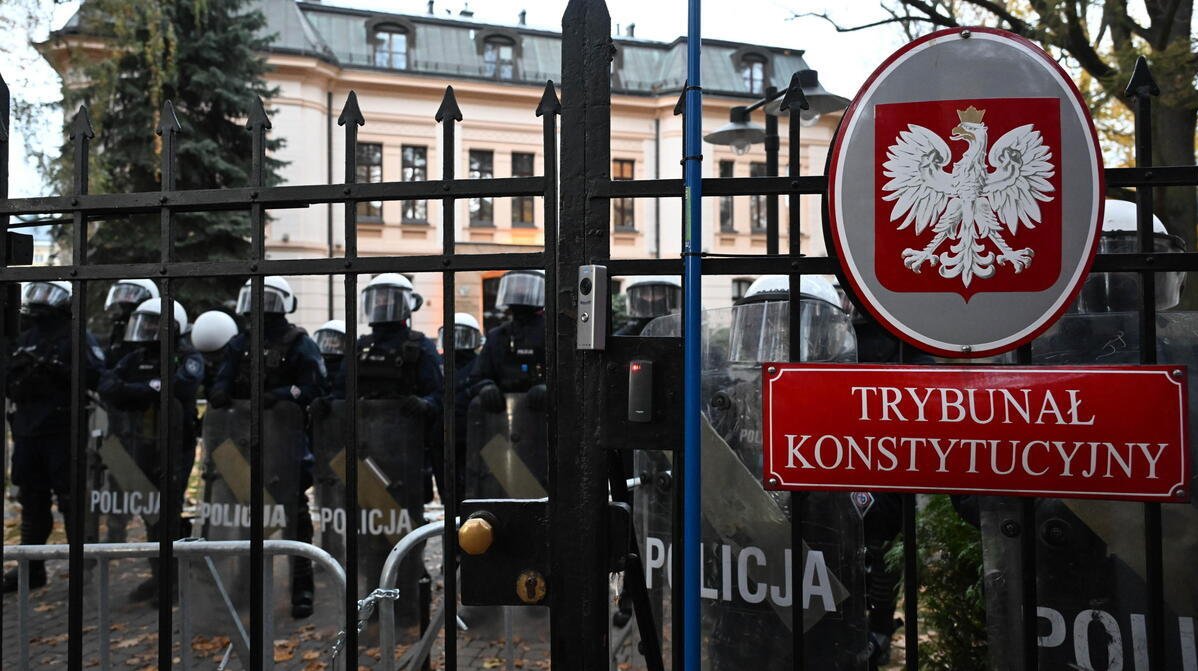
Between 30 and 31 October, the conflict over the Constitutional Tribunal entered a phase of open confrontation. Judge Anna Korwin-Piotrowska announced the suspension of the Tribunal’s president, Bogdan Święczkowski, and took over the post herself: a decision whose legitimacy is being challenged. President Karol Nawrocki denounced an illegal takeover; Donald Tusk’s government defended the move as part of restoring the rule of law. The affair forms part of the dispute over appointments and judicial independence that began under the governments of the Law and Justice party, PiS
For the economy, what matters most is the possibility that this dispute will prolong decision-making paralysis. If the institutions do not recognise the validity of each other’s acts, uncertainty increases over reforms and the stability of the rules. That does not mean every private contract suddenly becomes unsafe or that the whole judicial system stops working. It does mean, however, that an investor may seek greater guarantees, put a project on hold or demand a higher return to compensate for the perceived risk.
An economy with real defences
The starting point is favourable. According to the preliminary estimate from the Polish statistical office, in the second quarter of 2026 GDP grew by 3.9% year on year, in non-seasonally adjusted terms, and by 1% quarter on quarter in the seasonally adjusted series. The European Bank for Reconstruction and Development puts growth at 3.5% for 2026 and 2.8% for 2027, supported by investment and the absorption of European funds. These are assessments made before the latest institutional escalation, not estimates of its effects
The economy’s resilience stems from several factors. Domestic demand provides an important base for economic activity; integration into European production chains makes the country a manufacturing and logistics platform that is hard to replace quickly. Add to this skills, infrastructure and investments already made: assets that do not disappear because of a political crisis. A foreign company with plants and suppliers in Poland has good reasons to maintain its presence, even if it may become more cautious about expanding it.
There is also domestic financial support. In the consultation published in February, the International Monetary Fund described a banking sector that is stable, well capitalised and liquid, while flagging legal risks and fiscal distortions that can hold back credit. This is an important source of resilience: the institutional clash does not, on the information considered so far, coincide with a banking crisis
The first cost may be an investment that never gets off the ground
The economic consequences of the crisis could emerge first in future projects rather than current production. Building a plant, expanding a logistics centre or financing infrastructure means committing capital for many years. For these decisions, what matters is the stability of authorisations, fiscal predictability, the ability to settle disputes and the continuity of public policy. When those conditions appear less secure, waiting becomes a rational choice.
This is the channel through which an institutional crisis can impoverish an economy that is still growing without producing a recession straight away. GDP keeps rising, but less than it might have done; some planned start-ups are postponed, certain investments are scaled back, others are directed to rival countries. It would not be right to attribute these effects automatically to the tensions in Warsaw: European demand, energy and regional security remain decisive. The political clash does, however, add an internal risk to difficulties the country is already facing.
European funds: no automatic freeze, but confidence matters
The relationship with the European Union is one of the most delicate aspects. The previous rule-of-law dispute showed how institutional issues can affect funding. However, no automatic suspension of funds can be inferred from the current crisis: specific assessments and decisions would be required within the applicable mechanisms.
The most recent concrete figure considered points towards continuity. On 1 October the European Commission announced a payment of 7.9 billion euro to Poland under the Recovery and Resilience Facility, after verifying the agreed milestones. With that payment, the country had received 77% of its total allocation of 54.72 billion.
The risk therefore concerns the ability to preserve this relationship and turn resources into effective investment. A prolonged dispute could make it harder to implement reforms and reopen questions about institutional quality. Even without a fresh funding freeze, lost time in public decision-making would carry a cost for infrastructure, energy and productivity.
The public finances are the most vulnerable point
Sustained growth does not eliminate fiscal fragility. Poland has to fund defence, healthcare, investment and social commitments, while the deficit remains high. In this situation, the stand-off between president and government may make it harder to pass revenue measures or rein in certain spending. The economic problem is therefore not just the spectacle of the clash over the Tribunal, but the institutions’ ability to decide on a demanding budget.
On 18 September Moody’s had already cut the sovereign rating from A2 to A3. According to a statement from the Polish Finance Ministry, the agency justified the decision by citing the expected deterioration in fiscal strength, persistent deficits and rising interest costs. The decision predates the events of late October and should not be presented as a consequence of them. It does, however, show that vulnerability was already there and that greater political paralysis could worsen it
The economy can therefore keep growing while the state becomes more expensive to finance. If investors demanded higher yields on government bonds, part of the available resources would be absorbed by interest payments. Over time, less favourable financing conditions could also spill over to businesses.
The złoty, bonds and the stock market: where to watch for signals
Poland retains its own currency. The złoty can absorb some of the shock, but any weakening would have mixed effects: it could help some exporters while also making energy, imported components and foreign-currency debt more expensive. If pressure on the exchange rate were to feed inflation, the central bank would have less room to loosen monetary policy.
Bond yields also deserve attention, especially if any rise were accompanied by worsening fiscal expectations. On the stock market the effects would probably be uneven: banks, companies dependent on regulation and firms tied to public investment could react differently from exporters. These are possible transmission channels, not moves that can already be attributed to the latest crisis. Events developed between Friday evening and the weekend: the following sessions need to be watched before a judgement can be made on the market response
Industrial strength can limit the damage, not erase it
The least unfavourable scenario is a contained crisis, followed by a procedural agreement that restores predictability to the institutions. In that case, businesses could ride out the tension without significant macroeconomic consequences, and a reduction in uncertainty could help restart postponed projects. Any credible strengthening of judicial independence would also have long-term economic value, whatever the political cost of the compromise.
The more problematic scenario is a lasting confrontation capable of obstructing reforms, the budget and administrative decisions. It does not necessarily require capital flight or a recession: it can show up through more expensive credit, less ambitious investment and a gradual increase in the risk premium demanded by investors.
Poland is strong enough to withstand an institutional crisis; it is not strong enough to ignore its costs indefinitely. Its productive structure offers real protection, but to keep converging with richer economies it also needs recognised rules and credible public decisions. The real risk is that a country able to grow rapidly may end up using only part of its potential.
Tags
Related articles

Newsletter
The Patrimoni & Finanza newsletter
A considered selection of analysis on economy, Real Estate and wealth
The subscription service is not connected yet: no address is stored