
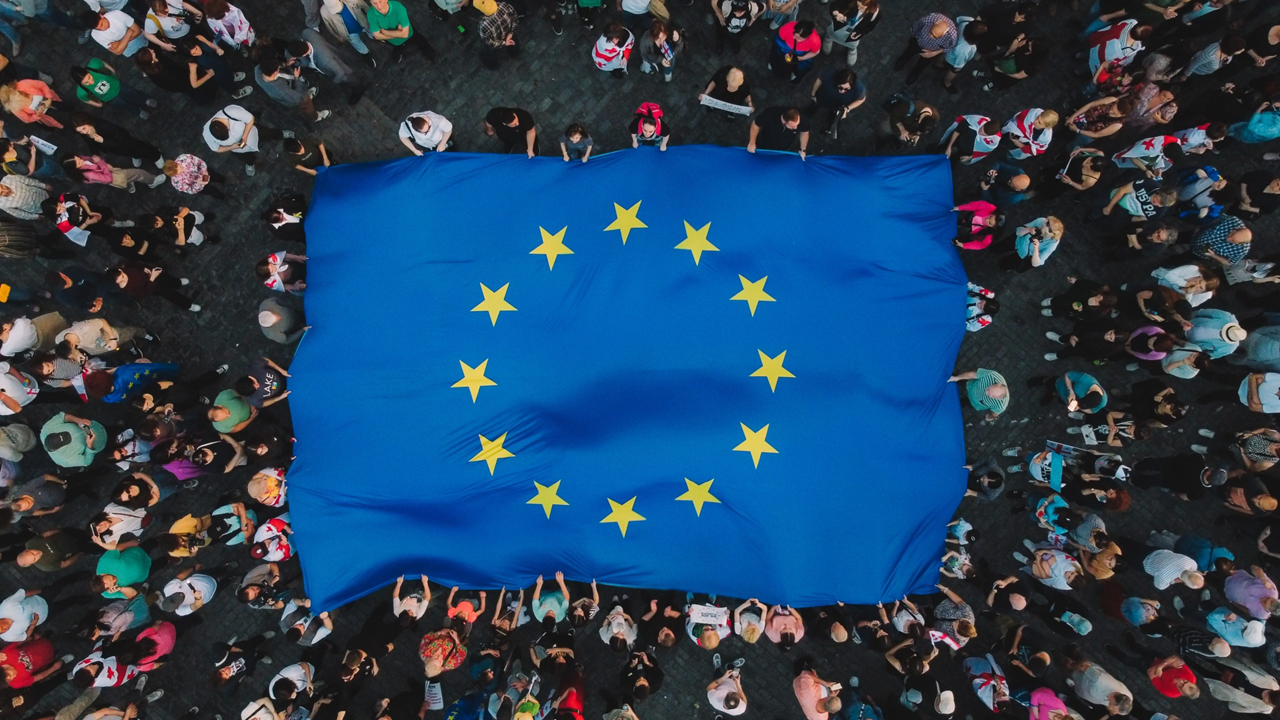
Would you die for this Europe? If the EU wants peace, it must build a civilization
"If you want peace, prepare for war" is the mantra of Europe’s top institutions. The return of the rearmament myth and the fragility of today’s Europe.
By Valerio Giunta, CEO of Startup Italia and Founder of Banking People
At the heart of the European institutions, as at the start of the 20th century, an old idea can be heard echoing: "To be heard in the world, we must rearm ourselves". This strange principle is also coming from openly Catholic politicians: "If Europe wants to avoid war, it must prepare for war", said Ursula von der Leyen at the Royal Danish Military Academy on 18 March 2025. A statement entirely similar to that made in 1909 by Sir Edward Grey, British Foreign Secretary, in his address to the House of Commons of the time ("A proper military preparation is the best guarantee of peace"). Two phrases, spoken more than a century apart, in two different eras yet identical in logic: peace is achieved by showing strength, respect is won with weapons, and diplomacy is effective only if backed by a fearsome arsenal.
It is the modern rewriting of the old Latin motto: "Si vis pacem, para bellum" (if you want peace, prepare for war). But in the 21st century, what does it mean to "prepare for war"? It means building next-generation weapons (especially nuclear ones), increasing the defense budget, developing military artificial intelligences, deploying autonomous drones, militarizing cyberspace. All this in a Europe that, paradoxically, no longer even has the workforce to produce those weapons, let alone the collective will to defend itself in earnest. Companies cannot find skilled workers, technicians, engineers; the hands and minds needed to build are missing—let alone soldiers for the EU to fight with. We are steeped in a culture of disengagement, of work-life balance as an absolute value and as a substitute for the ethic of duty, civic responsibility, shared identity.
The real crisis is not military, it is identity-based. Europe’s problem is not a lack of weapons, but a lack of ethos, of a common vision, of a collective identity worth living for and, if necessary, dying for. Without a cultural and spiritual foundation, any military strategy is an empty contrivance. We may have missiles, but we will have no motivation, no courage, no cohesion. What identity, then? Europe was born of Greek, Roman and Christian roots. It is Christianity that for centuries provided the moral compass, the spiritual cohesion that gave dignity to work, centrality to the person, and meaning to sacrifice. We have already seen the historical failure of "para bellum" in the decade before the First World War, when the European powers believed that preparing for war would guarantee peace. The result? 16 million dead, a devastated continent, fertile ground for the seeds of fascism and Bolshevism.
During the 20th century, the so-called Cold War, nuclear rearmament guaranteed an "incubus peace". The Cuban Missile Crisis of 1962 brought the world to the brink of apocalypse. Only secret diplomacy saved humanity — certainly not nuclear warheads. Today that logic is returning. But with more sophisticated technologies, lower attack thresholds and more unstable states. In this context, no one tells us that in 2024, European military spending exceeded Russia’s by 58% when calculated on a purchasing-power-parity basis and according to the NATO definition. Even considering only the EU and NATO countries, the advantage remains significant (+56%), and it still stands (+19%) if limited to the EU alone. Yet the effectiveness of this spending is undermined by structural fragmentation (Source: Università Cattolica del Sacro Cuore – Osservatorio CPI, 22 February 2025).
What does "structural fragmentation" mean? There is no unified command, operational doctrines are fragmented, weapons systems are not fully interoperable, and there is a lack of political and popular will to actually use them. Rearmament without technology and a spirit of growth is an illusion. This is confirmed by the two recent short conflicts:
1) in the "war" over Kashmir, Pakistan shot down several Indian fourth-generation fighter jets (including French Rafales) thanks to Chinese J-10Cs, which cost one-sixth of French Rafales (nb: China is bringing sixth-generation fighter jets to market). An emerging technology at very low cost, then, that beats Western technology. Markets rewarded Beijing, while Paris retreated into an embarrassing silence.
2) The US did no better against the Houthi: aircraft shot down, naval defenses bypassed, resilient militias: a superpower in difficulty against determined guerrillas.
Europe thus finds itself today at a historic crossroads: spend further billions on weapons, in a new illusion of "geopolitical weight" that masks internal fragility, or invest in culture, education, ethos, spirituality. A people’s true defense is not the steel of cannon, but moral fiber, combined with a school that teaches history, beauty and philosophy, with a society that is unashamed of its Christian roots, and with a politics that shapes citizens, not just consumers. Therefore, the motto to revive today is not "Si vis pacem, para bellum", but rather "Si vis pacem, para civitatem", that is, "If you want peace, build a civilization", a true community. Pope Francis himself said that peace is built "through work, justice, education and a culture of dialogue". He said it clearly during the World Day of Peace in January 2014: "Peace is not a good that comes from outside; it is a good that is born in the heart of man. It is built day by day, in work, justice, education and a culture of dialogue".
Consequently, Europe does not need to increase its military power; it only needs to rediscover itself. In this way it can once again speak to the world not with weapons, but with the quiet strength of a living civilization. A people’s strength is not in tanks, but in its ability to answer the question: "Who are we?". This means diverting investment away from arsenals — which enrich an industry, that of weapons, which needs periodic conflicts in order to be fed — and toward education and culture. Not into deterrence, but into social cohesion. Not into propaganda, but into a renewed European identity founded on ethos, community and Christian roots. This is the only real strategy for being relevant in the world, and once again a guiding civilization for peoples. Above all, for the European one.
Related articles

Newsletter
The Patrimoni & Finanza newsletter
A considered selection of analysis on economy, Real Estate and wealth
The subscription service is not connected yet: no address is stored